
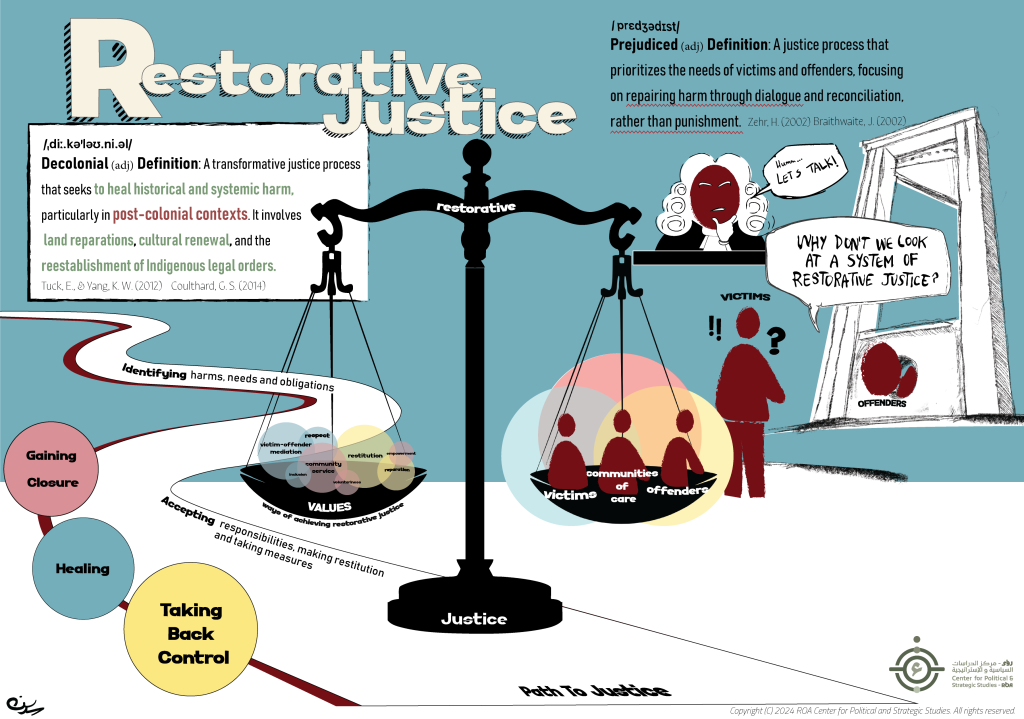
Restorative justice is a framework focused on healing harm through dialogue, accountability, and community involvement—offering an alternative to punitive legal systems. However, though restorative justice offers an alternative to punishment, its implementation within state frameworks can limit its potential for systemic change by upholding existing power dynamics. From a decolonial perspective, this can result in surface-level reconciliation that fails to address deeper structures of oppression such as colonialism, land theft, and historical violence.
Restorative justice, as framed by privileged academic and institutional contexts, is often presented as a progressive alternative to punishment. It centres on dialogue, accountability, and repairing harm between individuals, usually within state-sanctioned legal frameworks. However, this approach tends to universalise conflict and harm while ignoring power asymmetries and historical injustice; especially in colonial and settler-colonial contexts.
From a decolonial perspective, restorative justice must go beyond interpersonal reconciliation. It must address the structural and ongoing violence of colonialism. In other words, true justice cannot be achieved without confronting land dispossession, reviving Indigenous legal and governance systems, and rejecting settler recognition frameworks that maintain dominance under the guise of inclusion.
The decolonial approach reframes justice as collective, historical, and grounded in self-determination; not merely a restoration of the status quo, but a transformation of it.
- Decolonial Definition: A justice process that prioritizes the needs of victims and offenders, focusing on repairing harm through dialogue and reconciliation rather than punishment.
Tuck, E., & Yang, K. W. (2012). Decolonization is not a metaphor. Decolonization: Indigeneity, Education & Society, 1(1), 1-40.
Coulthard, G. S. (2014). Red skin, white masks: Rejecting the colonial politics of recognition. University of Minnesota Press.
- Prejudiced Definition: A justice process that prioritizes the needs of victims and offenders, focusing on repairing harm through dialogue and reconciliation rather than punishment.
Zehr, H. (2002). The little book of restorative justice. Good Books.
Braithwaite, J. (2002). Restorative justice & responsive regulation. Oxford University Press.
Copyright (C) 2024 ROA Center for Political and Strategic Studies. All rights reserved.
