
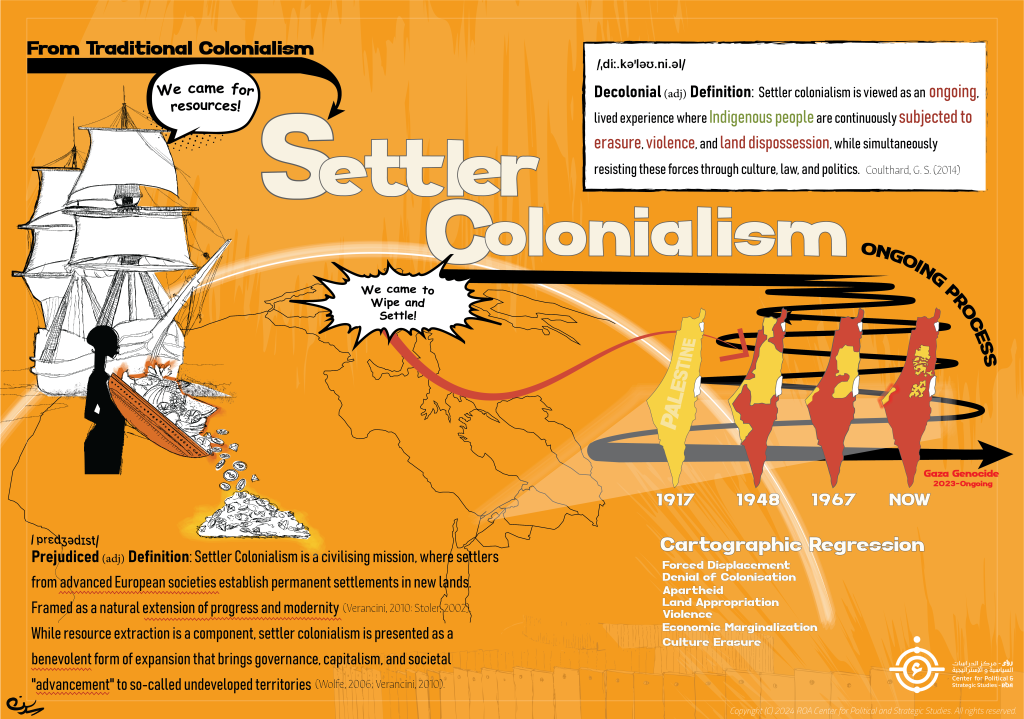
- De-colonial Definition: Settler colonialism is viewed as an ongoing, lived experience where Indigenous people are continuously subjected to erasure, violence, and land dispossession, while simultaneously resisting these forces through culture, law, and politics.
Coulthard, G. S. (2014). Red Skin, White Masks: Rejecting the Colonial Politics of Recognition. University of Minnesota Press.
- Prejudiced Definition: Settler Colonialism is a civilizing mission, where settlers from advanced European societies establish permanent settlements in new lands. Framed as a natural extension of progress and modernity. While resource extraction is a component, settler colonialism is presented as a benevolent form of expansion that brings governance, capitalism, and societal advancement to so-called undeveloped territories.
Veracini, L. (2010). Settler Colonialism: A Theoretical Overview. Palgrave Macmillan.
Stoler, A. L. (2002). Carnal Knowledge and Imperial Power: Race and the Intimate in Colonial Rule. University of California Press.
Smith, A. (2006). Heteropatriarchy and the Three Pillars of White Supremacy: Rethinking Women of Color Organizing. In Incite! Women of Color Against Violence.
Wolfe, P. (2006). Settler Colonialism and the Elimination of the Native. Journal of Genocide Research, 8(4), 387-409. https://doi.org/10.1080/14623520601056240
Copyright (C) 2024 ROA Center for Political and Strategic Studies. All rights reserved.
