Survey Overview
The survey examines eight interconnected dimensions: Viability and applicability of the Two-State Solution National justice and political narratives National priorities and political red lines Political actors, representation, and credibility Barriers to political participation and public dialogue Preferred channels for dialogue and engagement Psychological readiness, resilience, and collective hope Regional and international political dynamics
Methodology
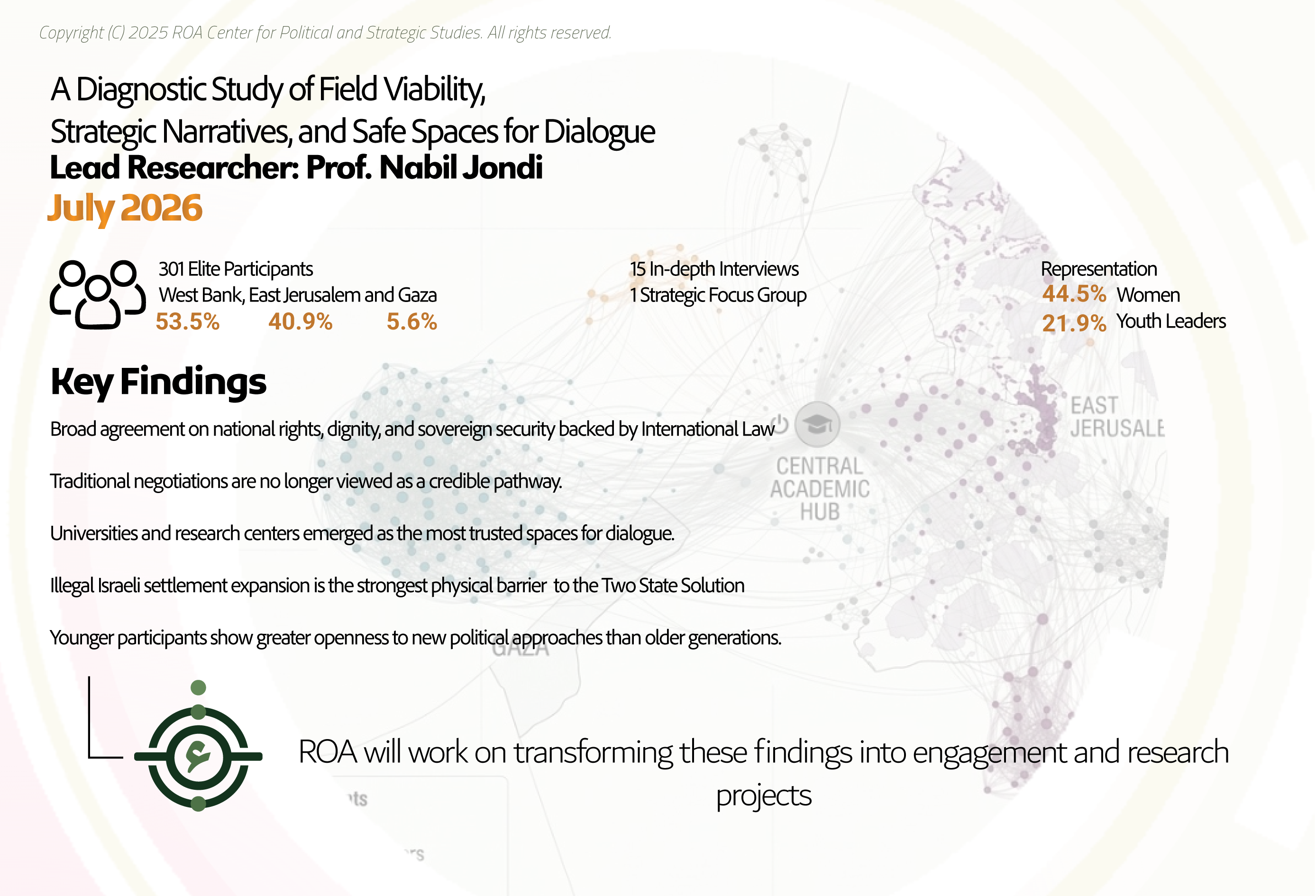
Sample: 301 stakeholders
Geographic Scope: West Bank, Gaza Strip, and East Jerusalem
Implementation Period: 17 April – 20 June 2026
Prepared by: Professor Nabil Jondi, Lead Consultant
Research Approach: Quantitative survey complemented by qualitative interviews and a strategic focus-group discussion
Key Findings
Mapping Viability, Narratives, and Political Engagement
RO’A Center for Political and Strategic Studies conducted a multi-dimensional stakeholder study examining Palestinian perspectives on the viability of the Two-State Solution, national political priorities, barriers to participation, political representation, and the possibilities for future national dialogue.
The study engaged 301 Palestinian stakeholders across the West Bank, Gaza Strip, and East Jerusalem, representing academic, political, civil society, media, activist, and private-sector perspectives.
Rather than measuring general public opinion, the study maps the perspectives of stakeholders with recognized expertise, professional experience, leadership roles, or influence in Palestinian public affairs.
Key Findings
The findings reveal a central tension between a strong commitment to Palestinian national rights and growing skepticism regarding the practical viability of the existing political process.
National priorities remain highly consistent.
The release of Palestinian prisoners emerged as the highest-ranked political priority, followed closely by sovereign security, East Jerusalem as the capital of a Palestinian state, control over natural resources, economic independence, refugee rights, and the removal of illegal settlements.
The viability gap is increasingly visible.
Settlement construction and settler violence were identified as the most significant material barriers to establishing a geographically connected Palestinian state.
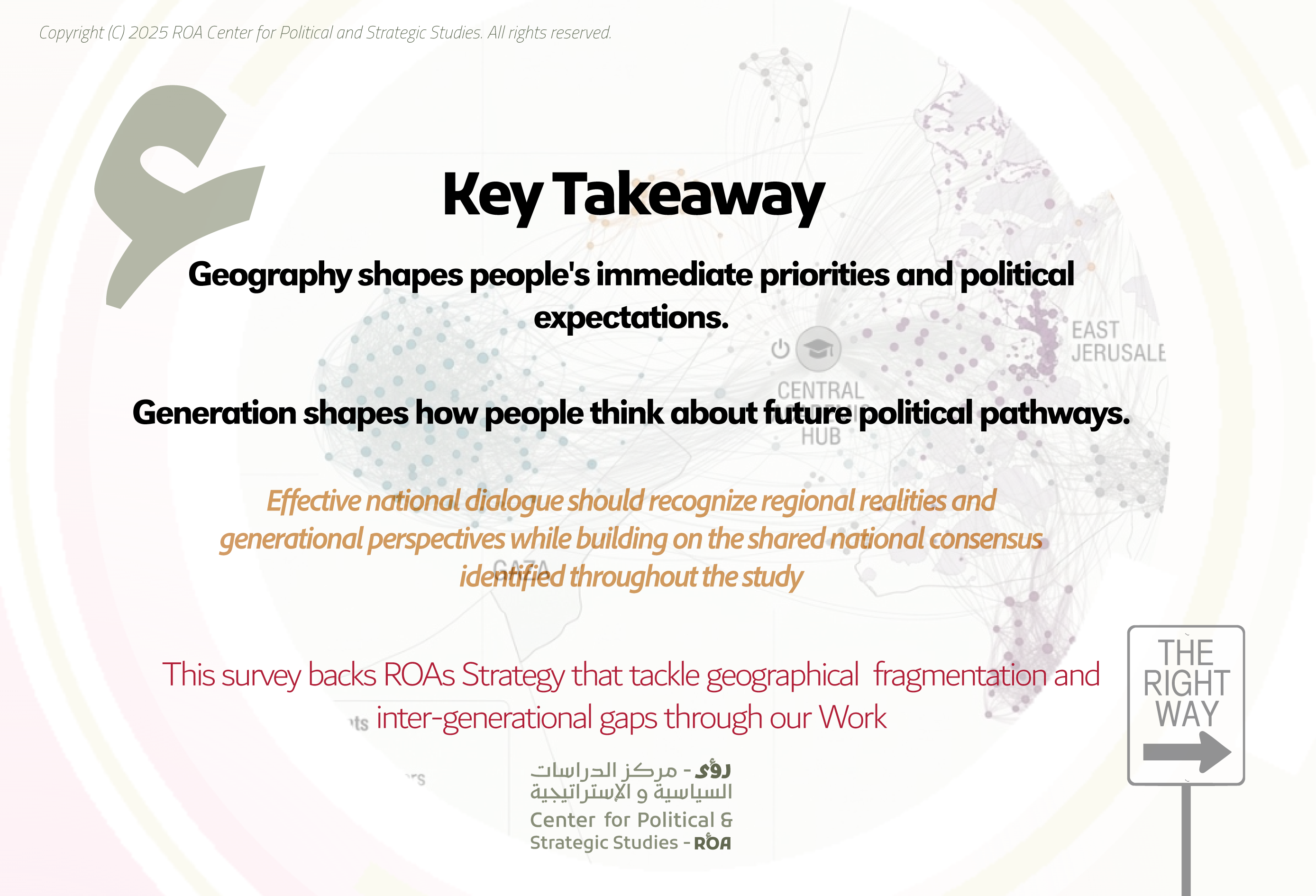
Geography shapes political perceptions.
Views differed considerably between respondents in the West Bank, Gaza Strip, and East Jerusalem, particularly regarding political compromise and the perceived feasibility of the Two-State Solution.
There is strong demand for new spaces for political dialogue.
Respondents expressed significant support for universities, research centers, civil society organizations, and independent professional figures as platforms capable of facilitating more credible and evidence-based national dialogue.
Youth and women remain underrepresented.
Despite their strong engagement with questions of rights and political futures, respondents identified limited youth and women’s participation in high-level political decision-making as an important structural barrier.