Survey Overview
The survey will help in gauging and analyzing the impediments, as well as opportunities, surrounding the potential for ending the occupation through conflict resolution. The outputs of this research will feed into the process of building a research-driven model for conflict resolution. The mapping will capture the current state of debate and the varying points of views/analyses and agendas regarding the Israeli occupation. As such the research focused on analysis of the present reality, factors contributing to the current state of affairs, background ideological inclinations and perceived feasible solutions to the conflict with end to the occupation, and engagement modalities. To achieve that, the research team interviewed 100 opinion leaders comprising state and non-state actors with influence on public opinion by utilizing their positions in decision-making or proximity to decision-making within political parties, government institutions, media influencers, civil society organizations, youth and women groups, academic and research institutions, private sector and business leaders, and labor and professional unions. The interviews were based on an agreed-comprehensive guiding protocol, and carried out by expert researchers. The response rate reached 67 per cent, while one third were unable or unwilling to participate because of time limitations or lack of motivation to participate as a result of disillusionment with the peace process and the resulting establishment of the Palestinian Authority.
Methodology
1. Design and finalization of the scope of work and ensuring a common understanding of the research key components and knowledge needs. This was achieved through extensive meetings with BI staff and consultants. 2. Design of the draft interview protocol (guiding themes and questions) to align with the scope of work. The protocol followed the proposed conceptual/analytical framework presented above. (The full protocol of guiding questions is in Annex 1) 3. Identification of opinion leaders: The research team defined opinion leaders as state and non-state actors with influence on public opinion by utilizing their positions in decision-making or proximity to decision-making within political parties, government institutions, media influencers, civil society organizations, youth and women groups, academic and research institutions, private sector and business leaders, and labor and professional unions. Most of the 100 participants in the mapping sample perform more than role and occupy more than one position, making any classification of their institutional affiliation an approximation of their most relevant position as deemed by them . The team estimates the non-response rate as one third of the original list approached ro interview (50 out of 150). Non-response was due to a number of factors including the many commitments that many of the leaders have and their busy schedules, the feelings of insecurity regarding their views and perceived potential threats by Israel and even Palestinian security agencies in the West Bank and Gaza. Most of all, non-response is due to a belief that this type of research is becoming increasingly irrelevant in the absence of a leadership that can transform results and recommendations into fruitful action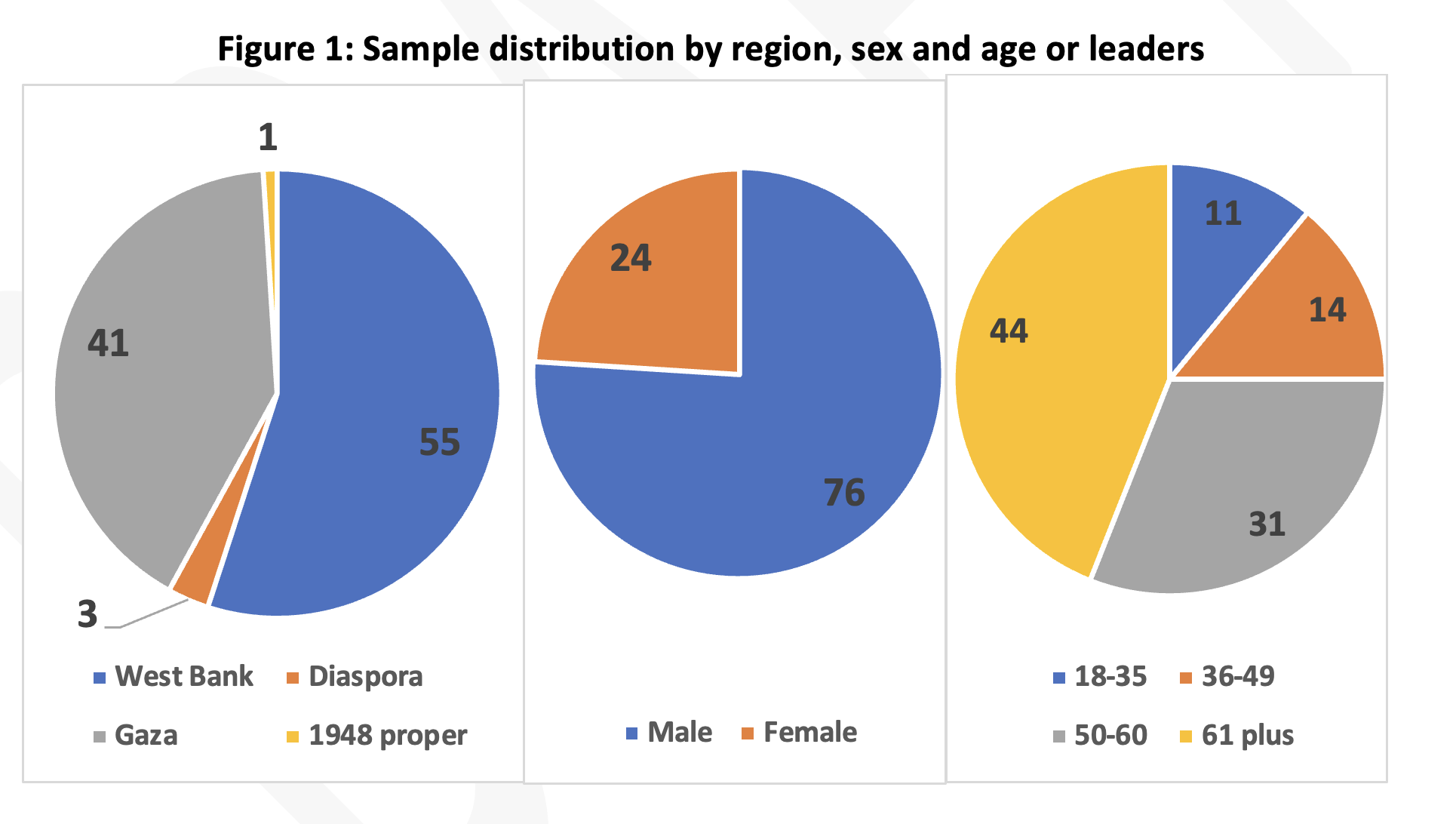
Key Findings
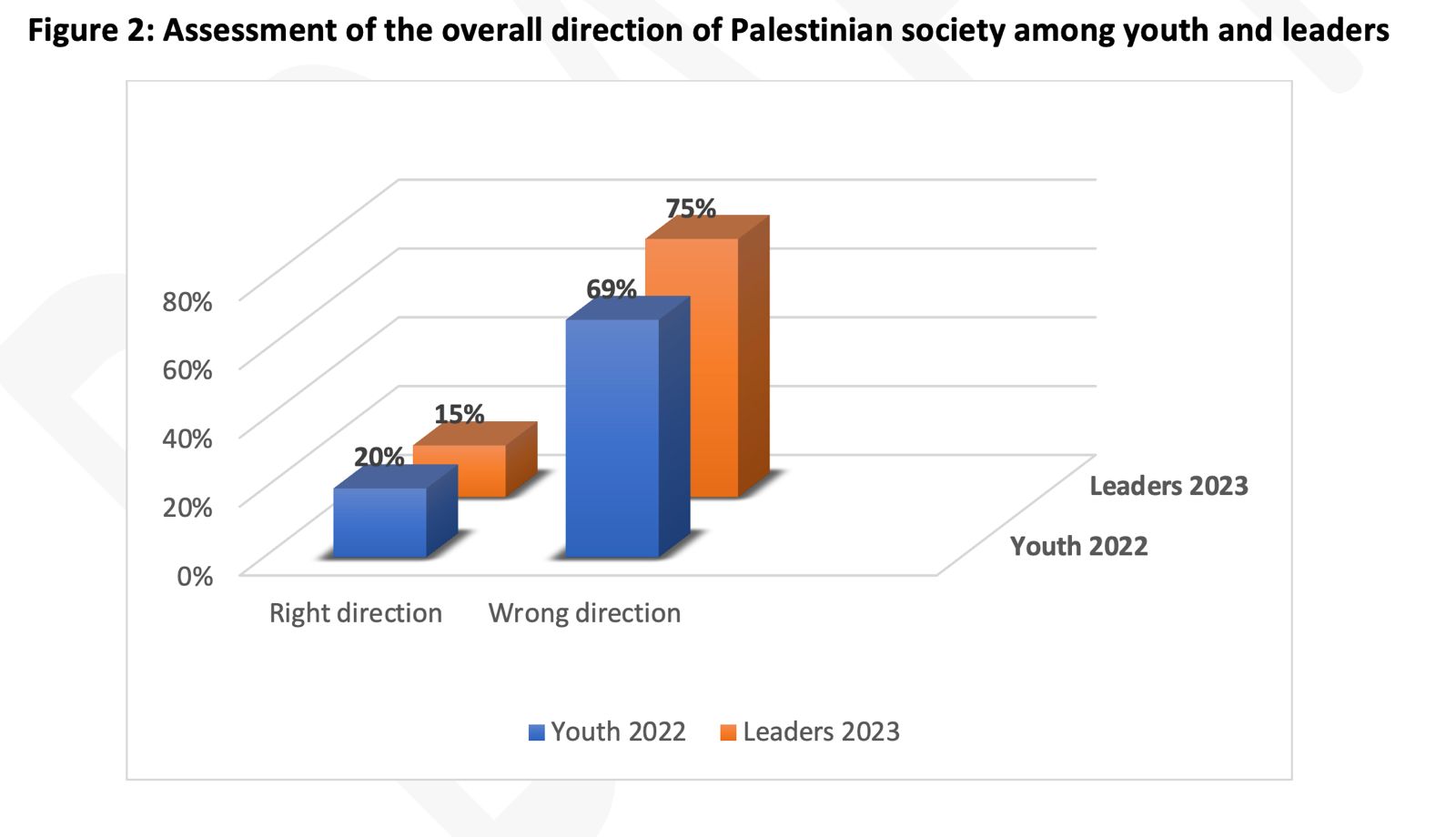
1) Overwhelming pessimism about local, regional and international geopolitical unfolding conditions: Leaders were pessimistic about the global and national forces that influence the success of the national project. On the world stage, the solidification of US hegemony and the shrinking space for national liberation movements were identified as the chief inhibiting factors, while nationally, leaders observed that Palestinians’ ostensible representatives are unable to cope with many of these changes, instead entrenching autocratic control of institutions and an atmosphere of securitization. As a result, leaders are incapable of articulating a coherent narrative or agenda, with leaders expressing skepticism of research and analysis as a sufficient driver to break this willful stagnation. The current state of affairs has prompted leaders to believe that political parties have failed Palestinians, though participants attributed the inability of a suitable figure to emerge on external forces, as well, principally the refusal by the Israeli occupation to accept any individual who is not pliant and docile. 2) Widespread belief that the Oslo process is not only obsolete, but detrimental: Overall, leaders concluded that the Oslo process or peace process has been a total failure, resulting from Israeli intransigence to concede control and their duplicity in dealing with Palestinians and international actors. Instead, the peace process served as a tool through which Israel was able to deepen its control of the West Bank, in the form of settlements and increased restrictions on Palestinians, while simultaneously advancing covert and overt partnerships with regional actors and fortifying its geopolitical position. Linked to the latter, leaders also observed that the international donor community has been complicit in Israel’s regime of intensified control as the money and legitimacy offered to the PA allowed this body to incapacitate the Palestinian struggle. 3) Bleak analysis of the condition around final-status issues: A large majority of leaders surveyed have a bleak view of the future, with 75 percent believing that Palestinian society is headed in the wrong direction. This negative outlook of contemporary circumstances is summarized in the rate of negative references, with words and terms like weak, regress, and hopeless outnumbering positive ones, including progress or achievement, by a factor of 5.5: 1. Though pessimistic in appraisals of representatives, participants did positively assess the Palestinian people, including civil society and resistance groups. Israel is viewed exclusively through the lens of its character as an occupying and colonial power, and Palestinians through their resistance and struggle against it. Comparatively few references were made to cooperation, partnership, and co-existence. In the instances that peace was mentioned it was in a derisive context, often ridiculing the way the word had been employed when describing the normalization agreements between Israel and Arab countries over the past years. 4) Recognition of the asymmetrical power of the occupier, while limited hopeful elements remain: When assessing the presence and role of local, regional, and global actors, Israel was mentioned more than any other, including the PLO, testifying to the dominating character of Israel and the occupation in all aspects of life. Consistent with perspectives on the conflict, virtually all references to Israel related to the occupation, its control and violations, and the expanding power of settler and religious groups. References to self-identifying Israeli peace groups were minimal, and, when occurring, were in critical contexts, faulting them for weakness and lack of genuine commitment. Further, leaders also indicated that the role of entrenching the Israeli occupation is not limited to military elements, but also includes the private sector, which both exercises near-total control over the resources and economy of Palestine while also attracting Arab regimes to normalize in hopes of economic benefit. 5) Shared analysis, varying conclusions on the role of Palestinian actors: In assessments of Palestinian actors, leaders presented varying perspectives. The PA was viewed in universally disappointing and critical terms, regardless of political affiliation. Few participants viewed the PA as a vessel for establishing a sovereign Palestinian state, as is its ostensible intent, instead viewing it as an instrument through which Israel divests its service delivery responsibilities to the Palestinians of the West Bank and Gaza, while simultaneously entrenching its control over the remaining territory of Palestine. When reflecting on the PLO, all participants noted the diminution of its role and influence, emphasizing that massive reform was needed to restore it to its role as the leader of the Palestinian people. Perspectives were most divided on the character of Hamas, with participants viewing it alternatively as the leader of the resistance against the Occupation, a driver for change in Palestinian society, and a force to conclusively finish the corroded and toxic Oslo paradigm, others view it as entrenching the division that has so deeply weakened Palestinians over the past decade, a means for regional powers to exert greater influence over politics in furtherance of their own aims, or free-riding off the PA’s commitments to services and payments in Gaza, while it invests in military or religious influence. 6) Regional actors as conspirators with increasing normalization of the occupation: Among regional actors, Iran, Egypt, and the Gulf monarchies were mentioned most frequently. Iran was noted for its ties to Palestinian resistance groups and its confrontational posture towards Israel. Egypt was considered particularly relevant given its strong influence and role in the affairs of Gaza, including mediating truces between Hamas and Fatah, as well as Hamas and Israel. On the global level, the US was the actor most commonly mentioned, with participants emphasizing the extensive military, financial, and diplomatic support it gives Israel in the latter’s entrenching of the Occupation of Palestine. In this regard, leaders expressed that the US has no credibility in its role as mediator. Perceptions of the UN and its agencies were divided. Some positively appraised the recognition of Palestine in various UN bodies and thought positively of the role of the ICJ, while others were more critical, noting how the UN, through the power of the US and Israel, acts as a harmful instrument against Palestine. 7) Israel as working towards – Maximum Colonization with Maximum Normalization: Leaders emphasized that both internal and external factors are dominated by the role of the Israeli occupation given its hegemonic control of the land. Fundamentally, participants believe the PA has been reduced to an entity that provides time and space for the occupation to exert greater control over Palestine, an identity shaped by its overall financial and political impotence, as well as the ability of the occupation to transform the political nature of the conflict to one about basic needs. The now decades-long split between Fateh and Hamas, occurring alongside deepening geographic fragmentation, limited political vision and economic capacity, and mushrooming corruption have all weakened the struggle acutely and deprived Palestinians of legitimate and credible representatives. Such adversities are compounded on the regional and international level, where the increasing pace of normalization between Arab and Muslim countries and the dwindling donor aid as a result of other regional crises have left Palestinians without allies or support. Internationally, the rise of right-wing parties in both the US and Europe have increased political pressures on the already enervated PA and UNRWA, while the fallout of the Ukraine War and COVID pandemic have increased basic needs while simultaneously diminishing previous assistance. Leaders also believe developments on the social and political level, principally the eroding of national consciousness and reference as a result of globalization and social media, present additional obstacles to success in the national struggle. 8) Moving beyond a 2-state solution, but towards the unknown: The majority of leaders have moved beyond belief in the two-state solution as a plausible outcome, though some continue to believe such a prospect can be resuscitated. Participants were similarly unenthusiastic for a one-state solution, owing to the supremacist character of Zionism, but believed that extant factors were making this outcome inevitable regardless of preferences. However, among leaders, the greatest dread was a consecration of the current cantonized system, whereby Israel maintains supreme control and affords the Palestinian polity little more than self-government. Among the so-called “final status” issues, leaders noted that the land grabbing of the settlement enterprise is the most pressing threat, given its role in nullifying a two-state solution. Jerusalem was the second most mentioned of the final status issues, followed by refugees, with most leaders expressing solid support for the full implementation of UN Security Council Resolution 194.