Survey Overview
Identify impediments and opportunities for ending the occupation through conflict resolution. Capture diverse viewpoints and agendas related to the Israeli-Palestinian conflict/occupation. Analyze current realities, contributing factors, and ideological solutions.
Methodology
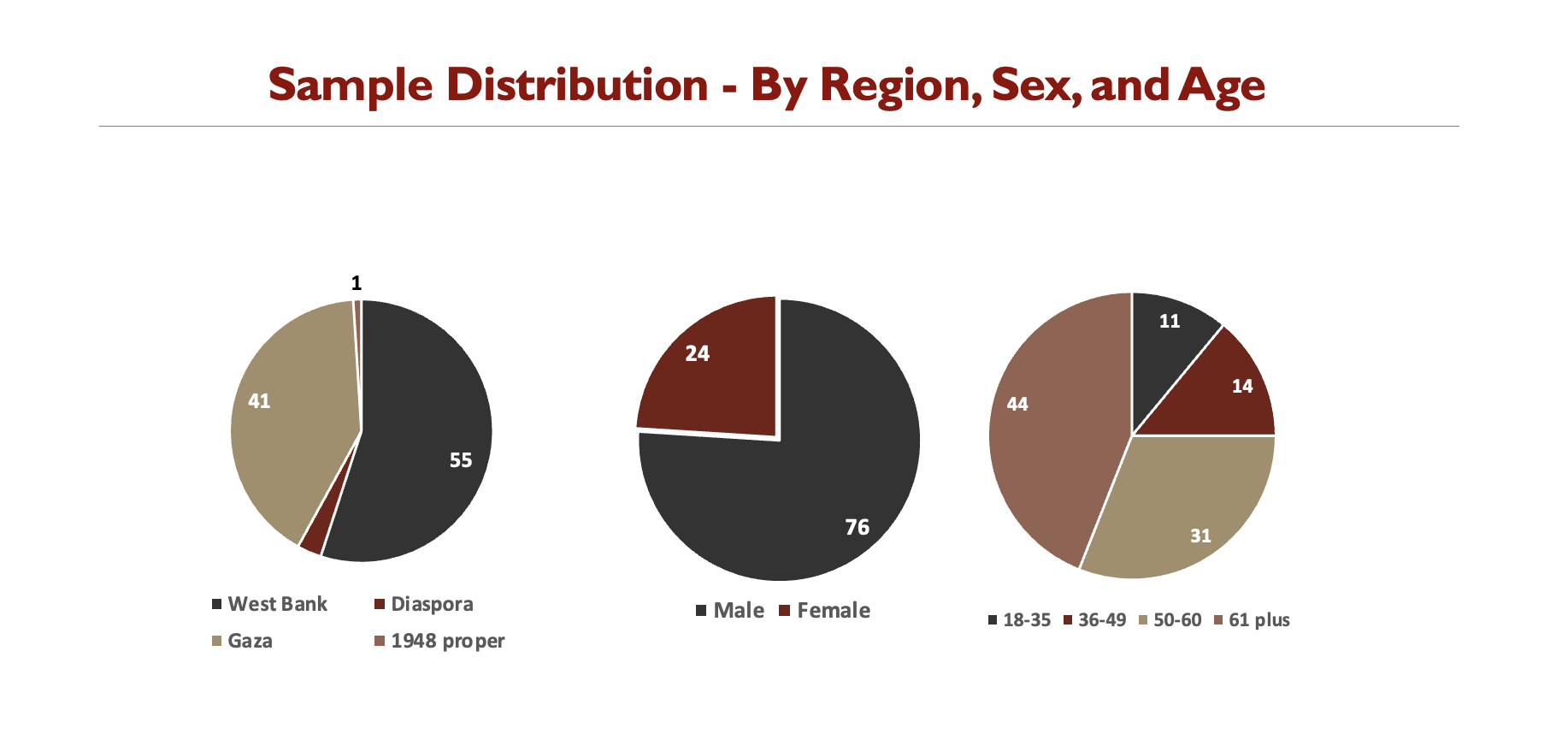
1 Consultative Preparatory Workshop
100 In-Depth Interviews
Key Findings
Key Findings: Geopolitical Factors
Overwhelming Pessimism: Pessimism regarding global conditions, including US/Israel hegemony, the Russia-Ukraine war, and the changing roles of China and Russia. New digital/virtual realities influencing young people.
Regional Factors:
- Instability, insecurity, and economic issues in Arab countries, diverting attention from the Palestinian cause.
- Normalization with Israel and shifts in relations with Turkey and Iran.
Israeli Factors:
- Israel's strengths in technology, agriculture, and security industries, and foster global interests.
- Rise of the religious-secular right-wing coalition and settler population's political influence.
-
Power Dynamics:
- Israel's dominating influence in the conflict.
- References to occupation, control, and violations.
- Limited mention of Israeli peace groups.
Economic Factors:
- Israel's private sector control over Palestine's resources.
- Normalization attempts for economic benefits.
-
Israeli side
# of mentions
Palestinian side
# of mentions
Occupation (colonial/colonialism)
2295
Resistance
697
Force/power/militarism
707
Struggle
540
Use of non-militaristic control tools (technology, civil society, etc.)
119
Armed resistance
143
Judaization/Jewish/Jews
636
Steadfastness
92
Fascism/apartheid/extreme/racist/discriminatory
91
Sacrifice/unjust/suffering/ violated/killing/imprisonment/ injury/ demolition/ strike/land expropriation/ movement restriction
435
The Palestinian Authority (PA):
- Universally disappointing and criticized by participants.
- Viewed as a tool for Israel to shift service responsibilities to Palestinians while solidifying control.
The Palestine Liberation Organization (PLO):
- Diminished role and influence acknowledged by all.
- Emphasis on the need for extensive reform to restore leadership status.
Hamas:
- Diverse views on Hamas.
- Some see it as a leader of resistance against the Occupation and a force for change.
- Others view it as entrenching division, serving regional powers, or relying on PA for Gaza services while investing in military or religious influence.
|
Actor |
# of mentions |
|
PLO/historic leadership |
1316 |
|
PA |
923 |
|
Hamas |
750 |
|
Fateh |
428 |
|
Youth/movement |
204 |
|
Palestinian left |
170 |
|
Youth militant groups (Jenin/Nablus) |
160 |
|
Religious groups (Palestinian) |
136 |
|
Islamic Jihad |
130 |
|
Civil society/NGOs |
102 |
|
Other leftist groups (DFLP) |
65 |
Regional Actors:
Prominent mentions of Iran, Egypt, and Gulf monarchies.
Iran:
Noted for ties to Palestinian resistance groups and confrontational stance toward Israel.
Egypt:
Relevant due to the strong influence in Gaza, mediating truces between Palestinian factions and Israel.
Gulf countries:
Financial and internal political role vs. normalization with Israel.
Prominent Global Actor:
- The US was frequently mentioned.
- Highlighted for providing extensive military, financial, and diplomatic support to Israel in maintaining the Occupation.
- Credibility questioned in the US’s role as a mediator.
Perceptions of the UN:
- Mixed views on the UN and its agencies.
- Positive appraisal for recognizing Palestine in UN bodies and the role of the ICJ.
- Criticism regarding the UN's perceived harm against Palestine due to the influence of the US and Israel.
Hegemonic Control System (Centaur): Israel's strategy is summarized as 'Maximum Colonization with Maximum Normalization.'
Actors & Influencing Parties (International)
|
Indicative wording |
# of mentions |
|
USA |
612 |
|
EU/West/countries |
354 |
|
UN/international institutions |
170 |
|
Russia/Ukraine |
204 |
|
China |
124 |
Israel’s Approach
Maximum Colonization with Maximum Normalization
Hegemonic Control System (Centaur): Israel's strategy is summarized as 'Maximum Colonization with Maximum Normalization.'
Challenges Faced by Palestinians
Palestinian Authority (PA):
- PA is reduced to an entity providing time and space for occupation.
- Identity is shaped by financial and political impotence.
- Conflict transformed into a struggle for basic needs.
Internal Division and Weakness:
- Decades-long split between Fateh and Hamas.
- Geographic fragmentation and limited political vision, economic challenges, and corruption weaken the struggle.
Regional and International Factors:
- Normalization between Arab and Muslim countries.
- Diminishing donor aid due to other regional crises.
- Lack of allies or support.
International Pressures:
- Rise of right-wing parties in the US and Europe.
- Impact of the Ukraine War and COVID pandemic on assistance.
- Social and Political Developments:
- Erosion of national consciousness due to globalization and social media.
Majority Shift:
Most leaders no longer consider the two-state solution plausible, though some hold onto the possibility of its revival.
Alternative Solutions
One-State Solution:
- Leaders are generally unenthusiastic due to Zionist supremacist character.
- Belief that extant factors may lead to a one-state outcome regardless of preferences.
Concern for Cantonized System:
- The greatest concern among leaders is the consecration of the current cantonized system with supreme Israeli control and limited Palestinian autonomy.
Final Status Issues
Pressing Threat:
Land grabbing by settlements was highlighted as the most pressing threat, undermining the two-state solution.
Jerusalem:
Jerusalem is mentioned as the second most critical final status issue.
Refugees:
Refugees discussed, with strong support for full implementation of UN Security Council Resolution 194.
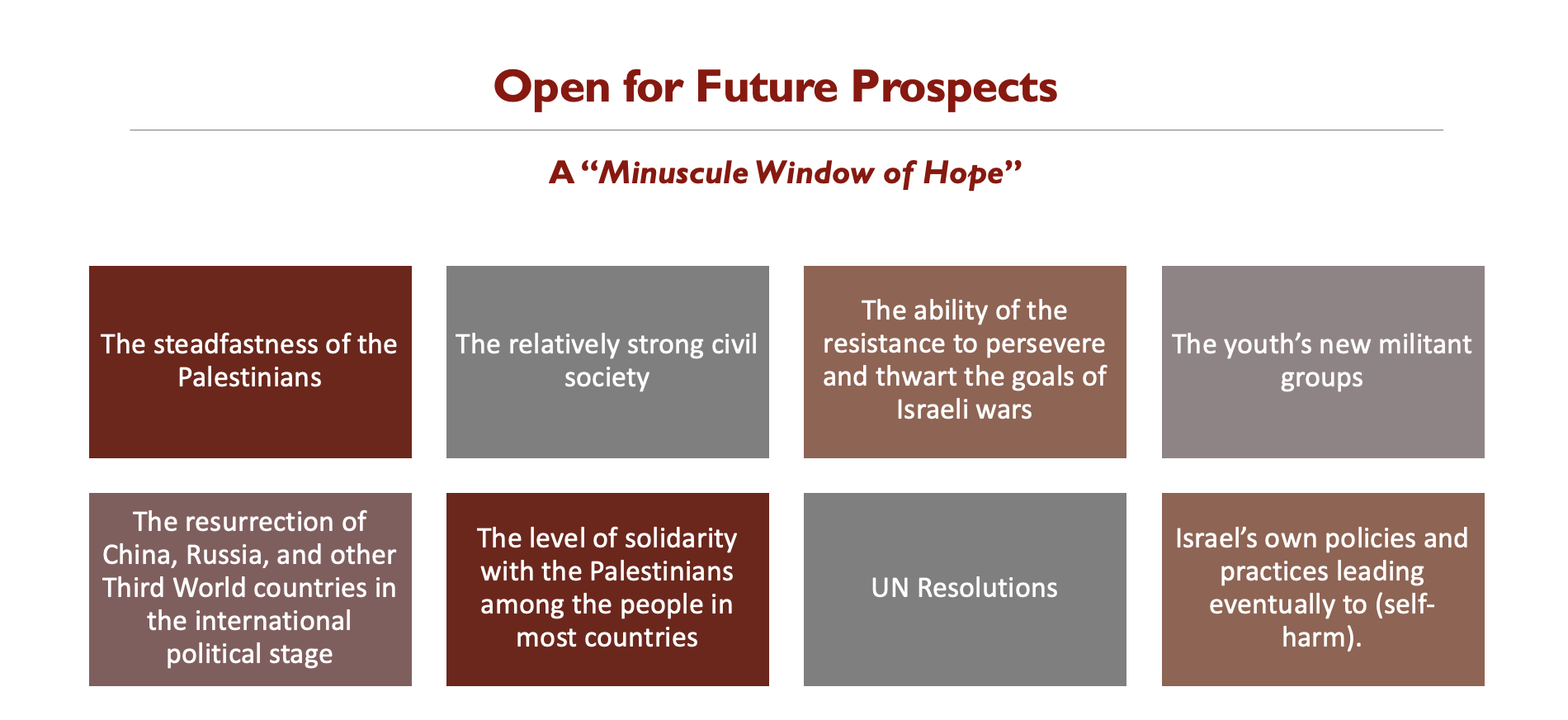
Summary of Opportunities and Future Prospects
Bleak analysis of the conditions around final-status issues; yet optimism continues among a minority
A large majority of leaders surveyed have a bleak view of the future, with 75 percent believing that Palestinian society is headed in the wrong direction
A Nationalist Agenda Continues to be at the Core of the Discourse;
Even with the Rise of Islamist Agendas
|
Indicative wording |
# of mentions |
|
Palestine/Palestinian |
7362 |
|
Nationalism/nationalist (Palestinian)/national identity |
1241 |
|
Historic Palestine/1948/occupied Palestine (now Israel) |
391 |
|
Islam/Islamic/Islamist |
238 |
|
Arabism/Pan Arabism |
17 |
|
Liberalism/new liberalism |
41 |
|
Secularism |
41 |
Sovereignty over Land as Core to all Other Issues
|
Type of state |
# of mentions |
|
Two-state solution/independent state 1967 |
228 |
|
Historic Palestine as the ultimate solution |
146 |
|
Self-Governance regime |
31 |
|
One-state solution |
27 |
|
Confederation (Egypt/Jordan) |
10 |
|
Bi-national state |
7 |
|
Confederation with Israel |
6 |