Survey Overview
The study aims to identify key stakeholders, examine the relationships and power dynamics between them, explore areas of agreement and disagreement, and support the development of more informed strategies for dialogue, consensus-building, peacebuilding, and policymaking.
Methodology
The mapping combined desk research, expert consultation, and focus-group discussions to identify and assess relevant stakeholders within the Palestinian context.
7
Experts & Key Informants
3
Focus Groups
94
Mapped Entities
30
Stakeholder Groups
10
Main Stakeholder Categories
Desk research was used to identify potential actors, while consultations with seven experts and key informants helped validate and expand the stakeholder list. Three focus groups with civil society representatives and academics contributed additional perspectives on the conflict-resolution environment and further refined the mapping.
Key Findings
Mapping the Conflict-Resolution Landscape
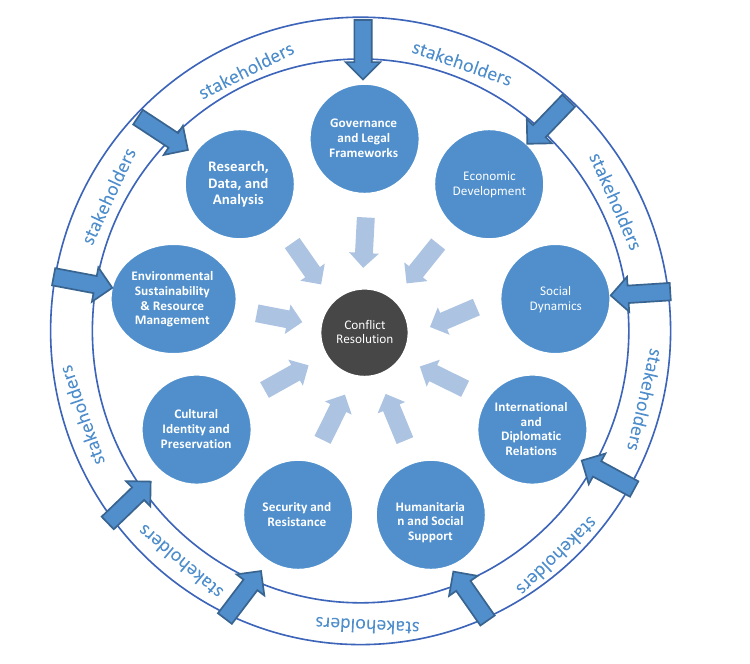
The study assesses stakeholders according to nine interconnected factors influencing conflict resolution:
- Governance and Legal Frameworks
- Economic Development
- Social Dynamics
- International and Diplomatic Relations
- Humanitarian and Social Support
- Security and Resistance
- Cultural Identity and Preservation
- Environmental Sustainability and Resource Management
- Research, Data, and Analysis
This framework allows stakeholders to be examined according to the particular areas in which they operate and influence Palestinian political and social realities.
Who Was Mapped?
The research initially identified 30 stakeholder groups and 94 individual entities, later organized into ten overarching categories representing different forms of influence within Palestinian society and the broader conflict-resolution environment.
These categories include:
Political Entities · NGOs · Grassroots & Community Organizations · Professional & Academic Institutions · Private Sector · Media & Influencers · International Actors · Diaspora · Armed Groups · Clans & Tribes
Measuring Influence and Engagement
Rather than simply identifying who the stakeholders are, the study examines how much influence they hold and how actively they engage within different areas of conflict resolution.
Each stakeholder was positioned according to two dimensions:
Impact
The stakeholder's level of influence or ability to shape outcomes within a particular area.
Activity / Engagement
The extent to which the stakeholder is actively involved in initiatives, processes, or interventions related to that area.
Importantly, a high level of activity does not necessarily correspond to a high level of influence.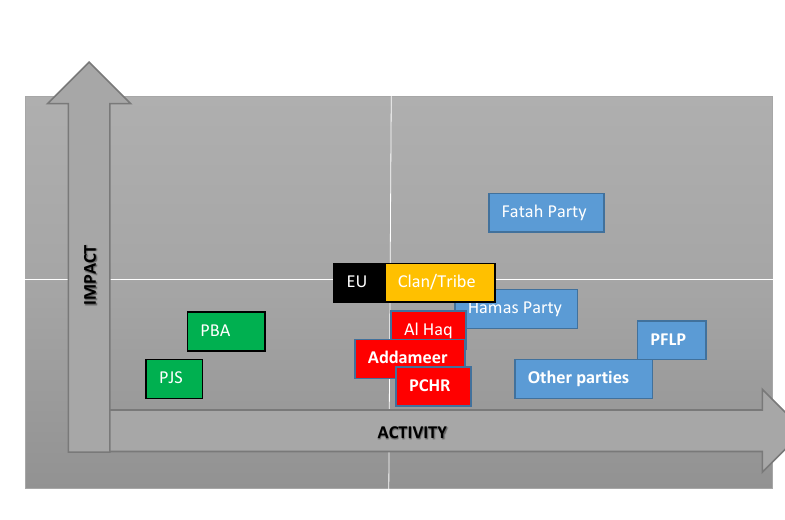
Governance & Legal Frameworks — Impact / Activity Map
Use the stakeholder grid here as an example of how actors are positioned.
The maps reveal the different combinations of influence and engagement held by political actors, civil society organizations, international institutions, professional bodies, community actors, and others across each conflict-resolution factor.
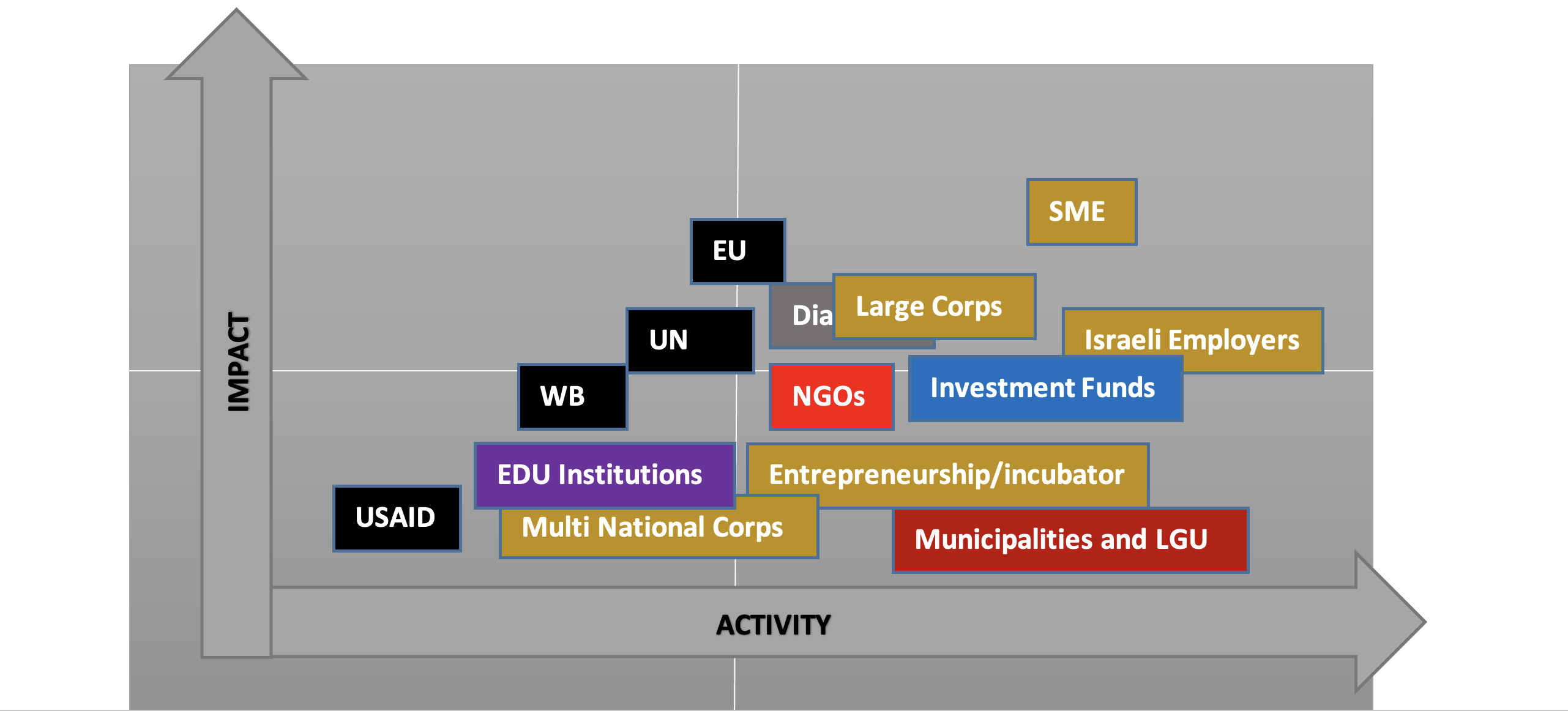
Economic Development — Impact / Activity Map
Use a second stakeholder grid here to show how the composition and positioning of actors changes according to the issue being examined.
From Mapping to Engagement
The study is intended not only to describe the stakeholder landscape, but to support more strategic engagement with it. Its recommendations emphasize inclusive participation, multi-stakeholder dialogue, cross-sector collaboration, consensus-building, grassroots initiatives, data-driven policymaking, and the continued updating of the stakeholder map as political and social dynamics evolve.
Because stakeholder influence can shift over time, the report recommends periodically revisiting the mapping framework to capture emerging actors and changing levels of influence and engagement.