
Survey Overview
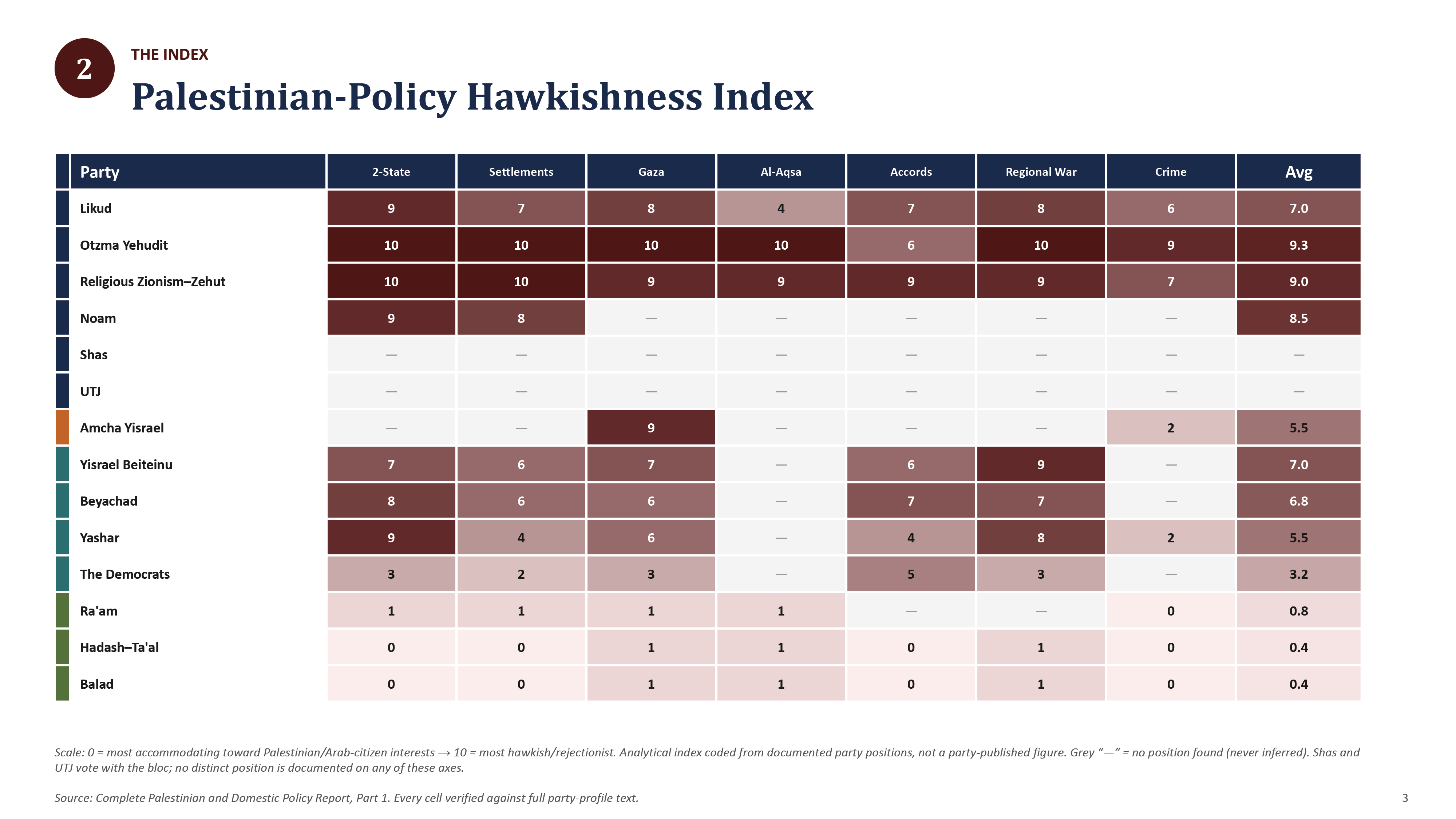
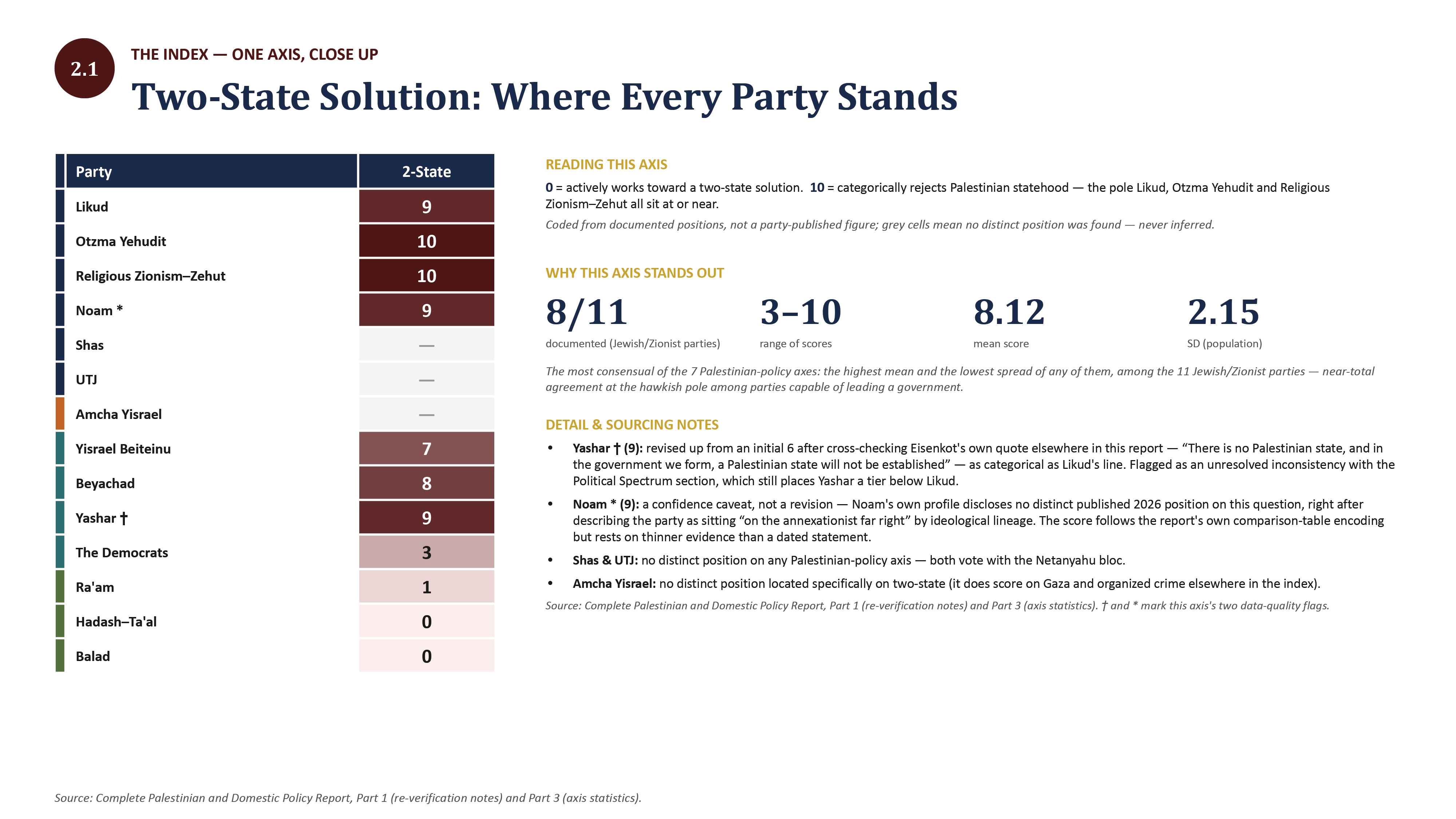
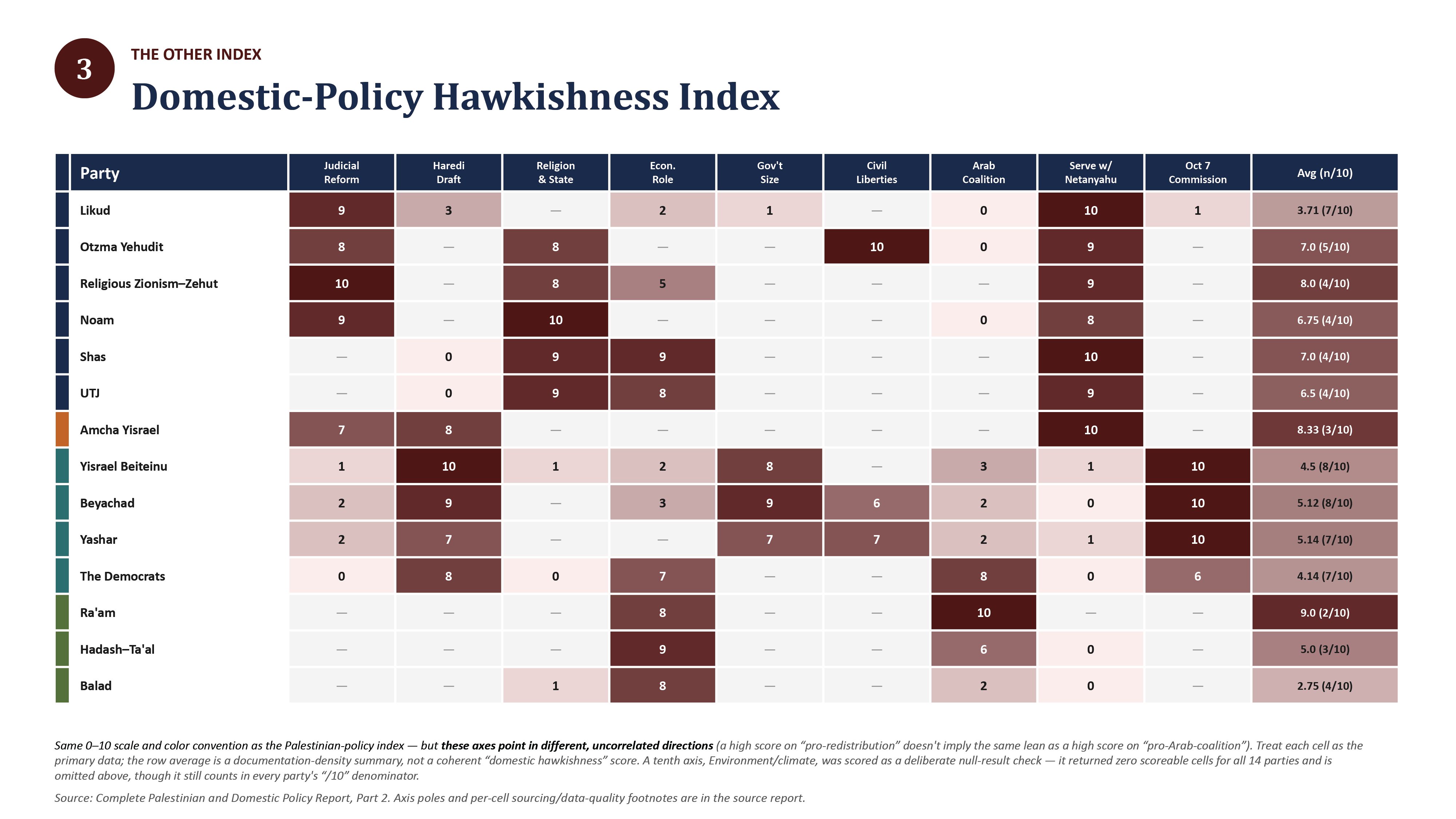
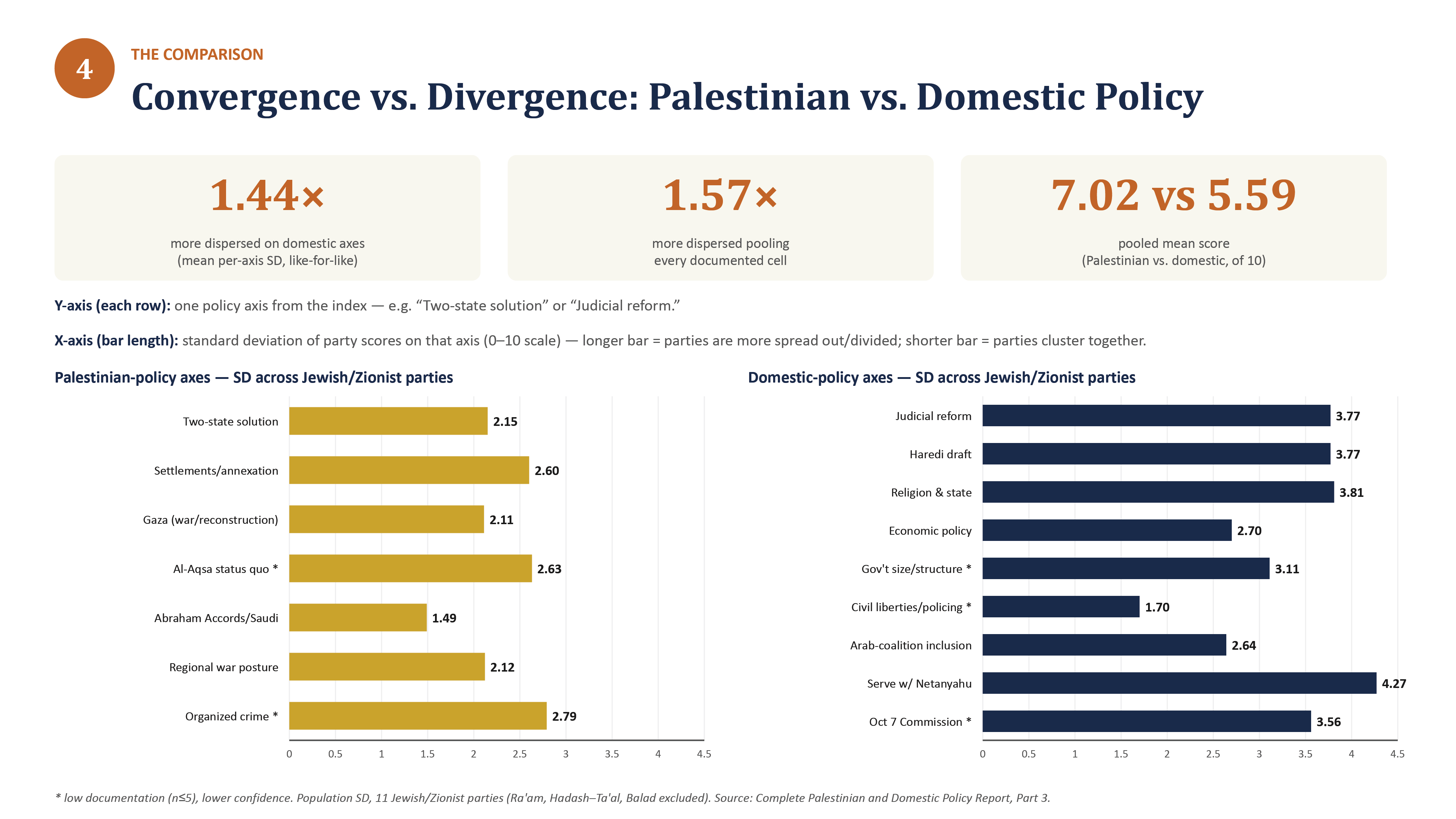
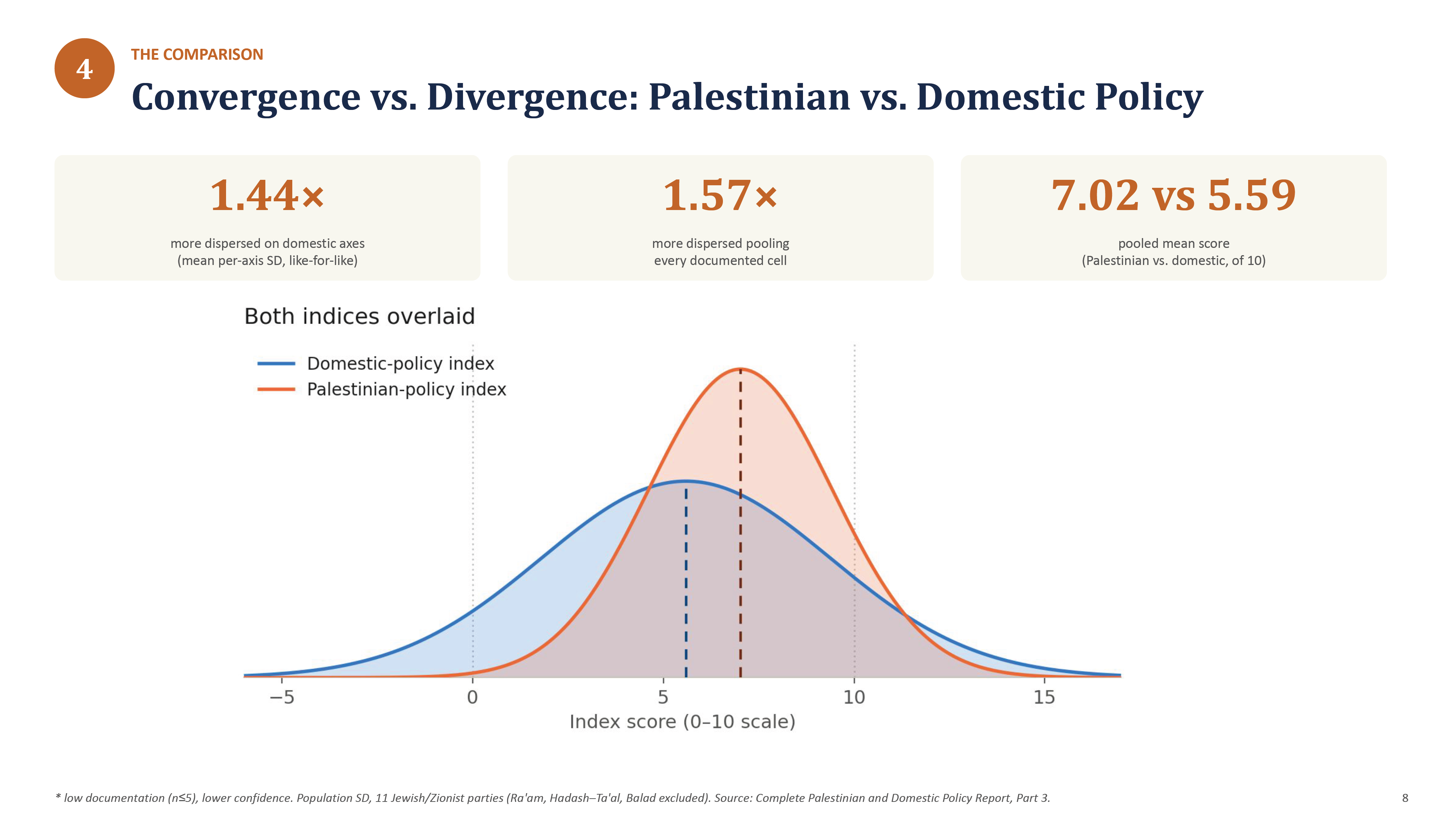
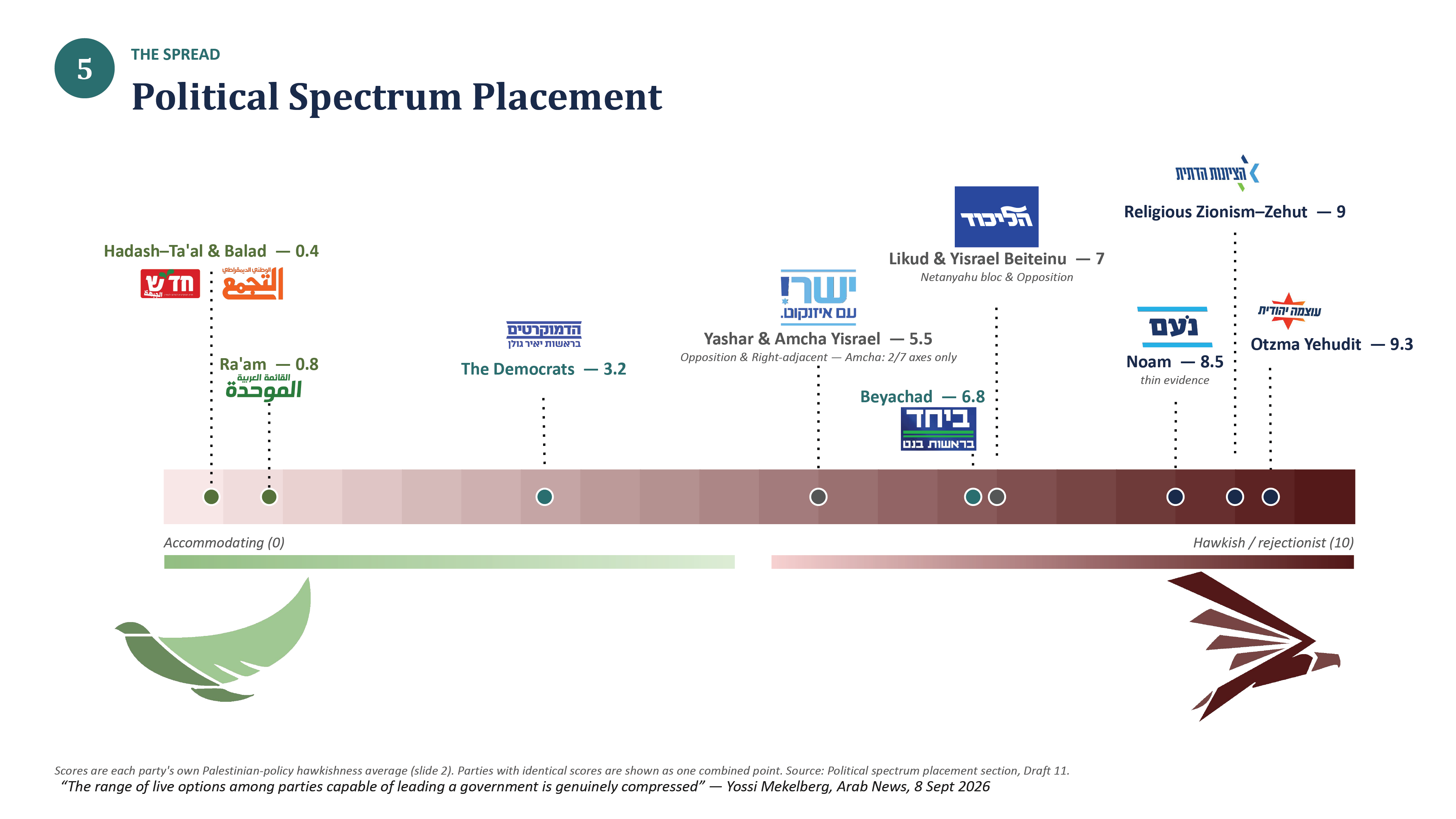
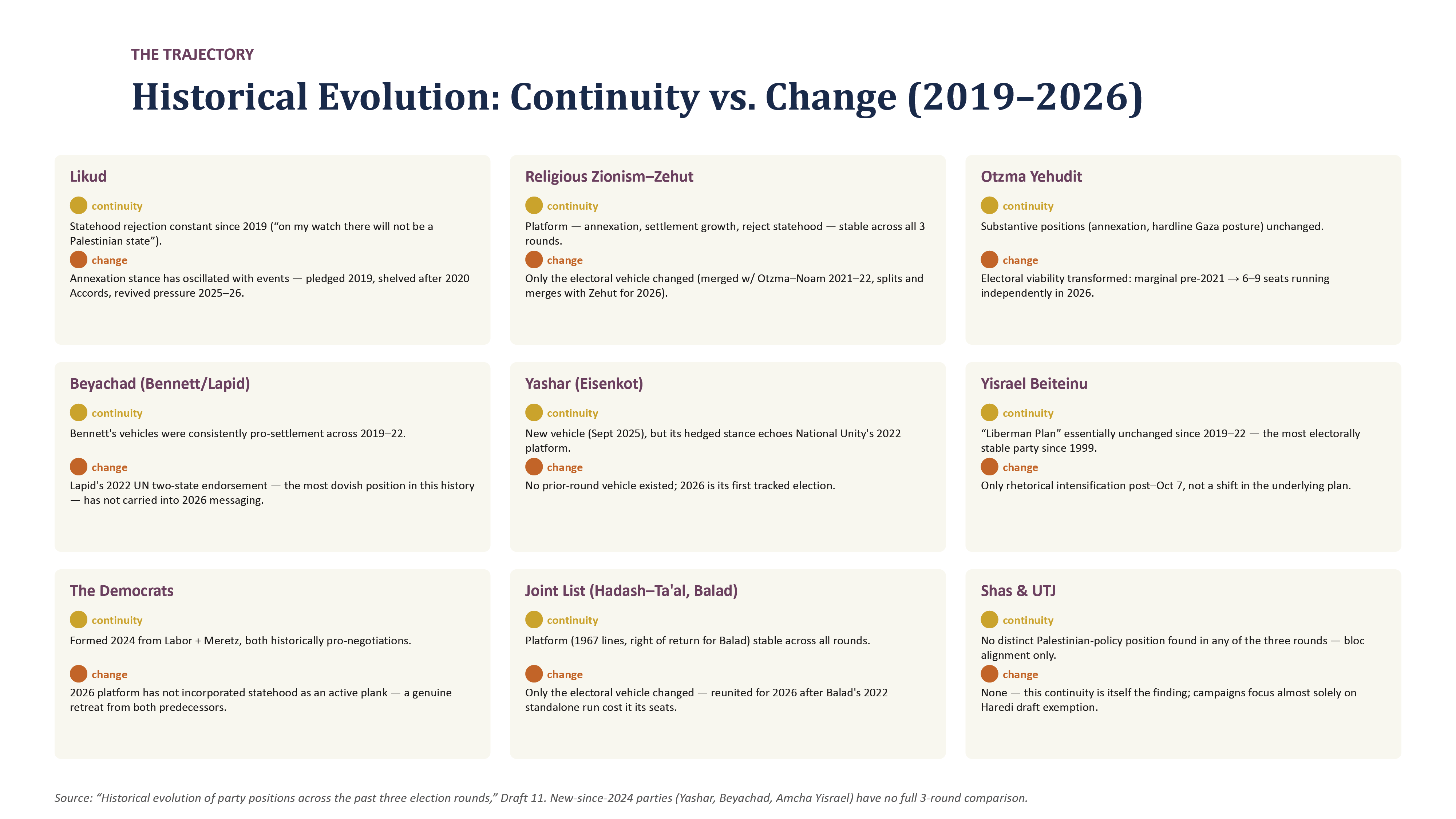
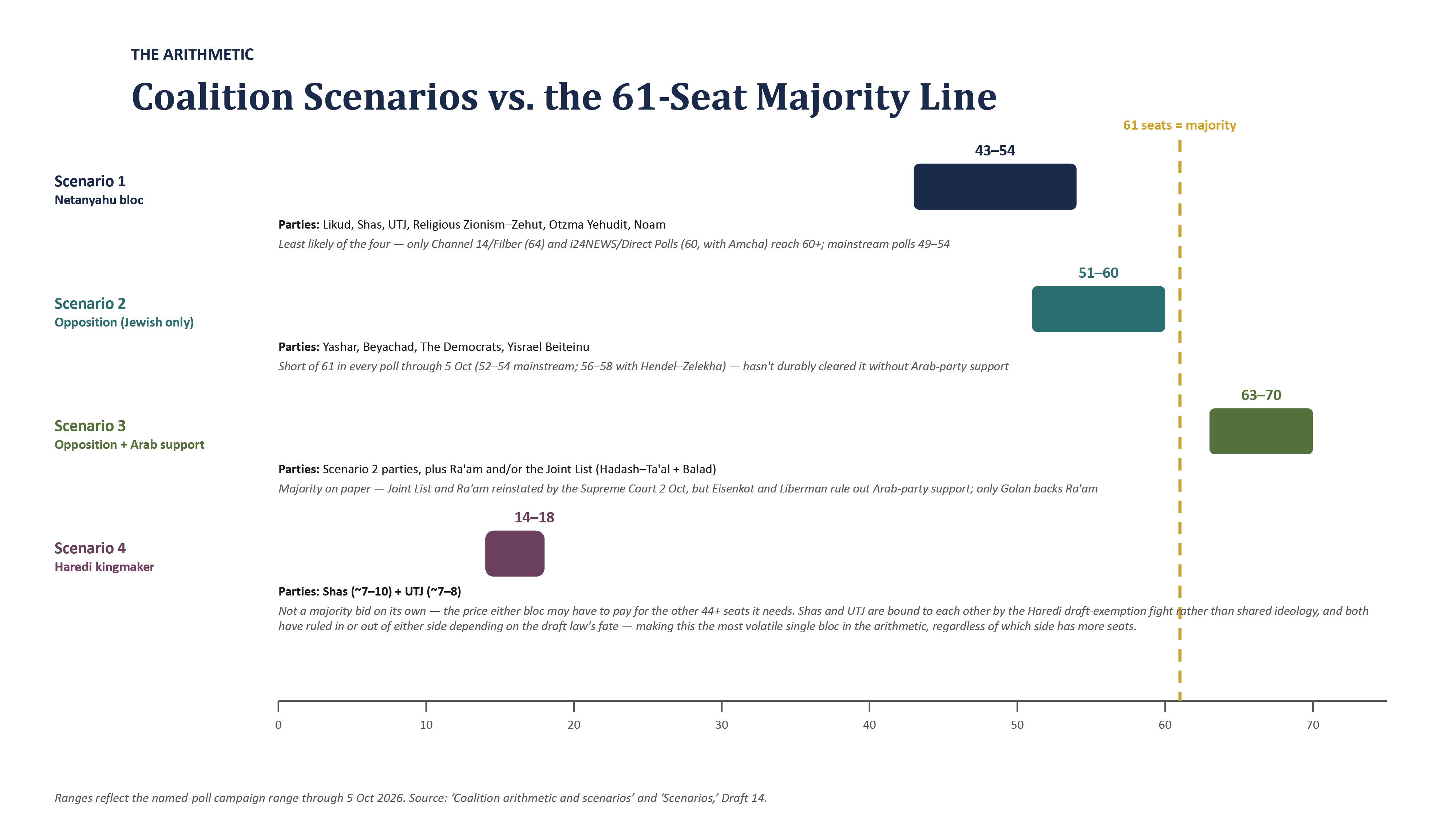
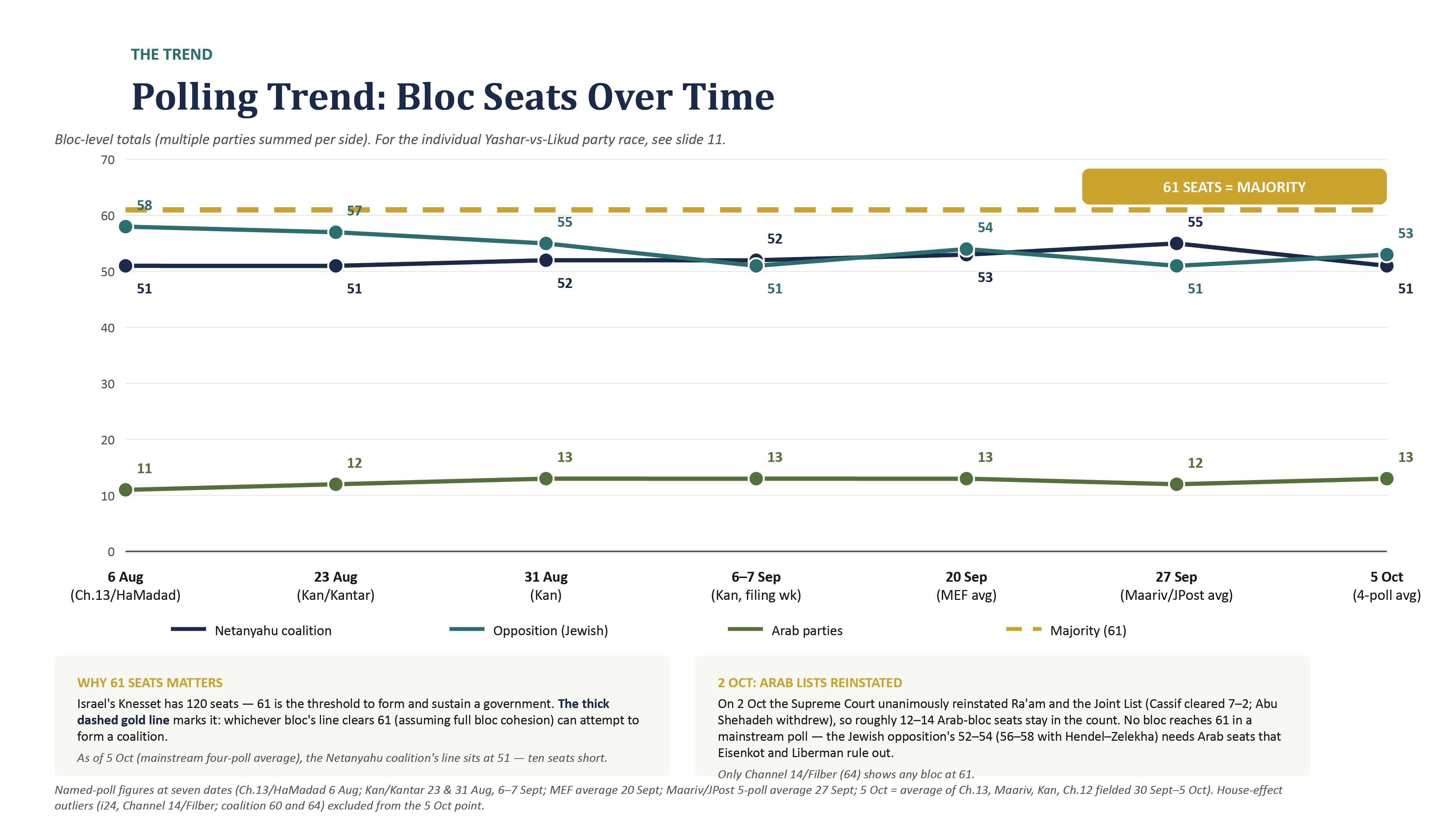
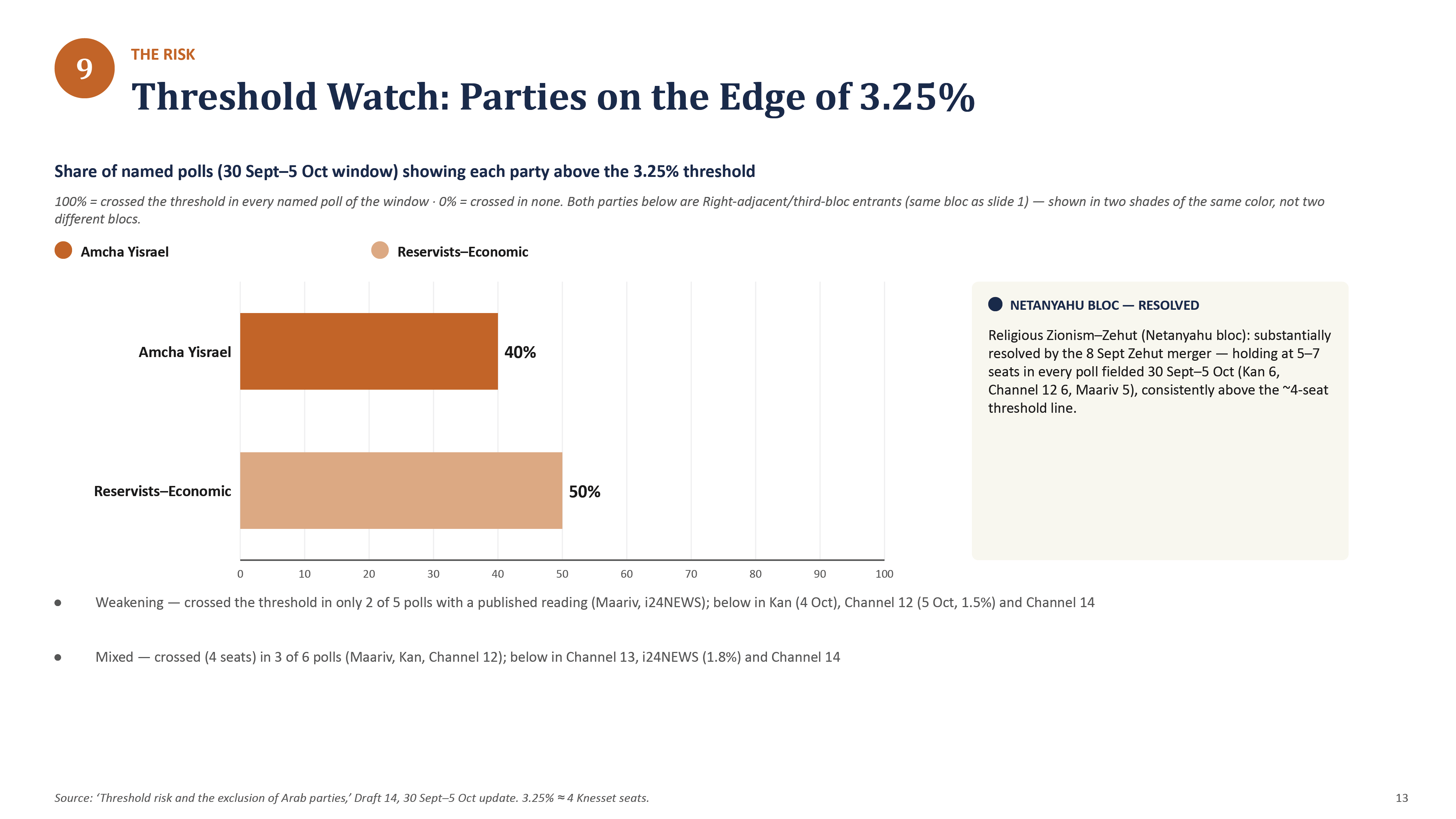
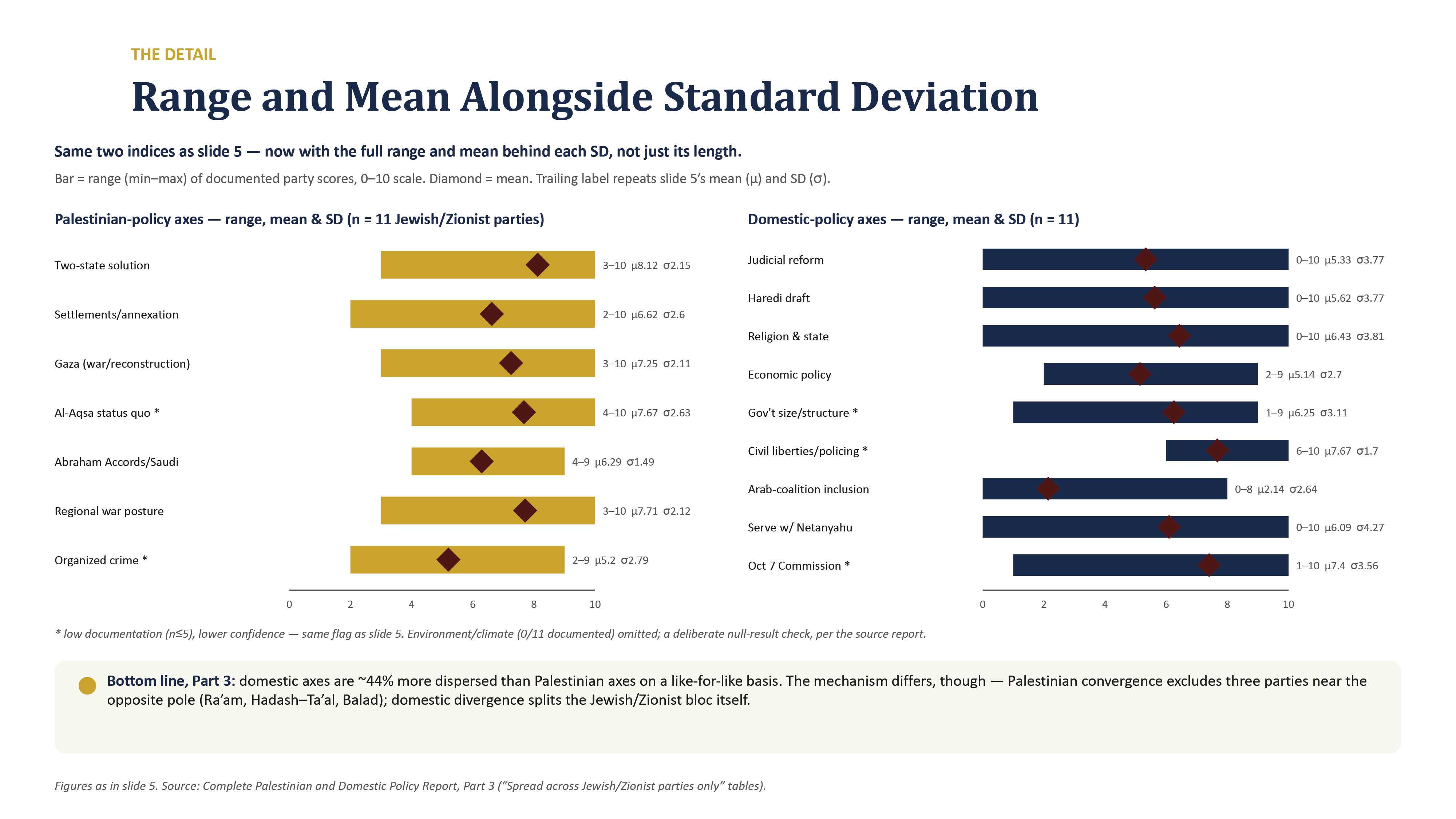
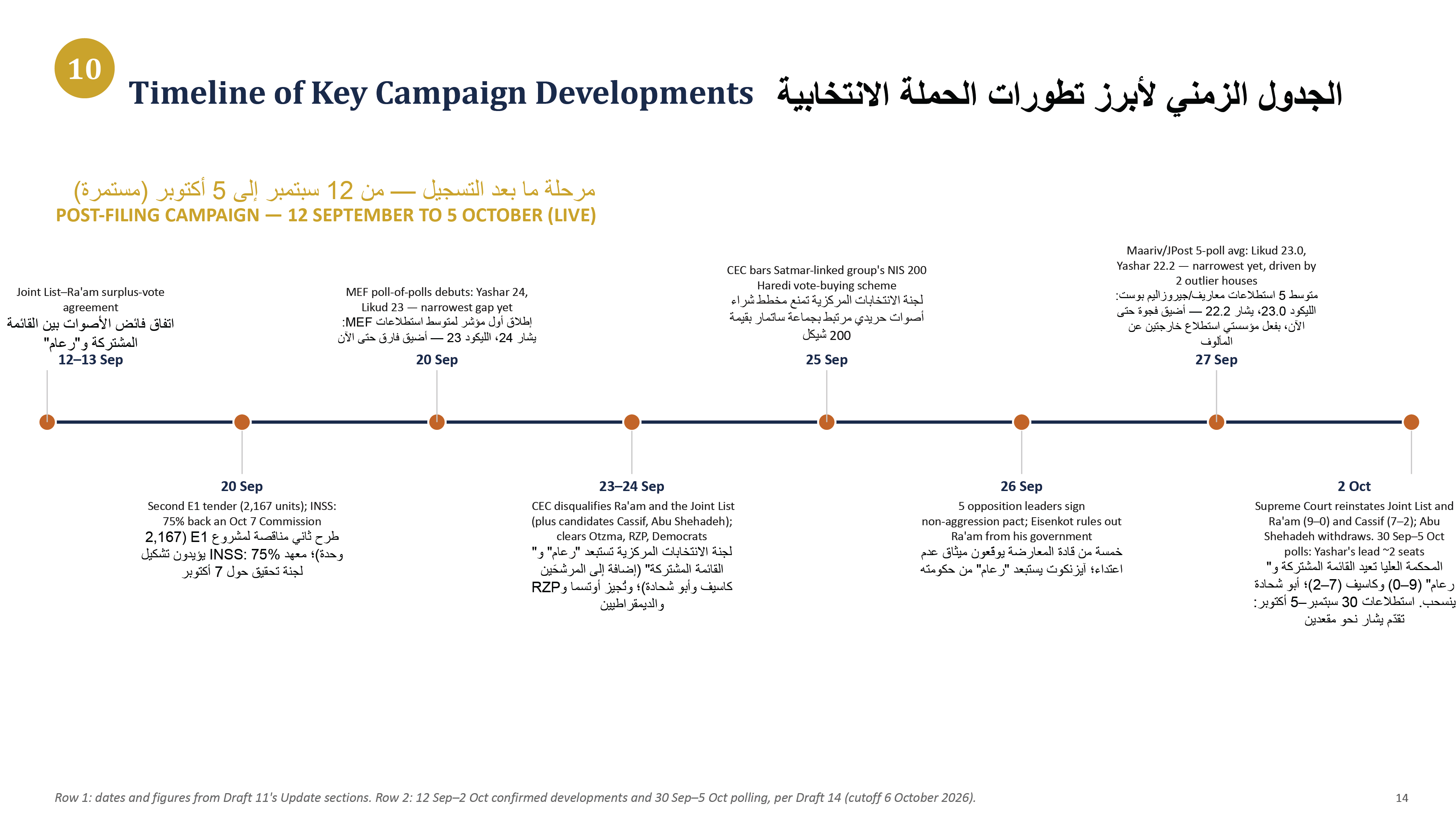
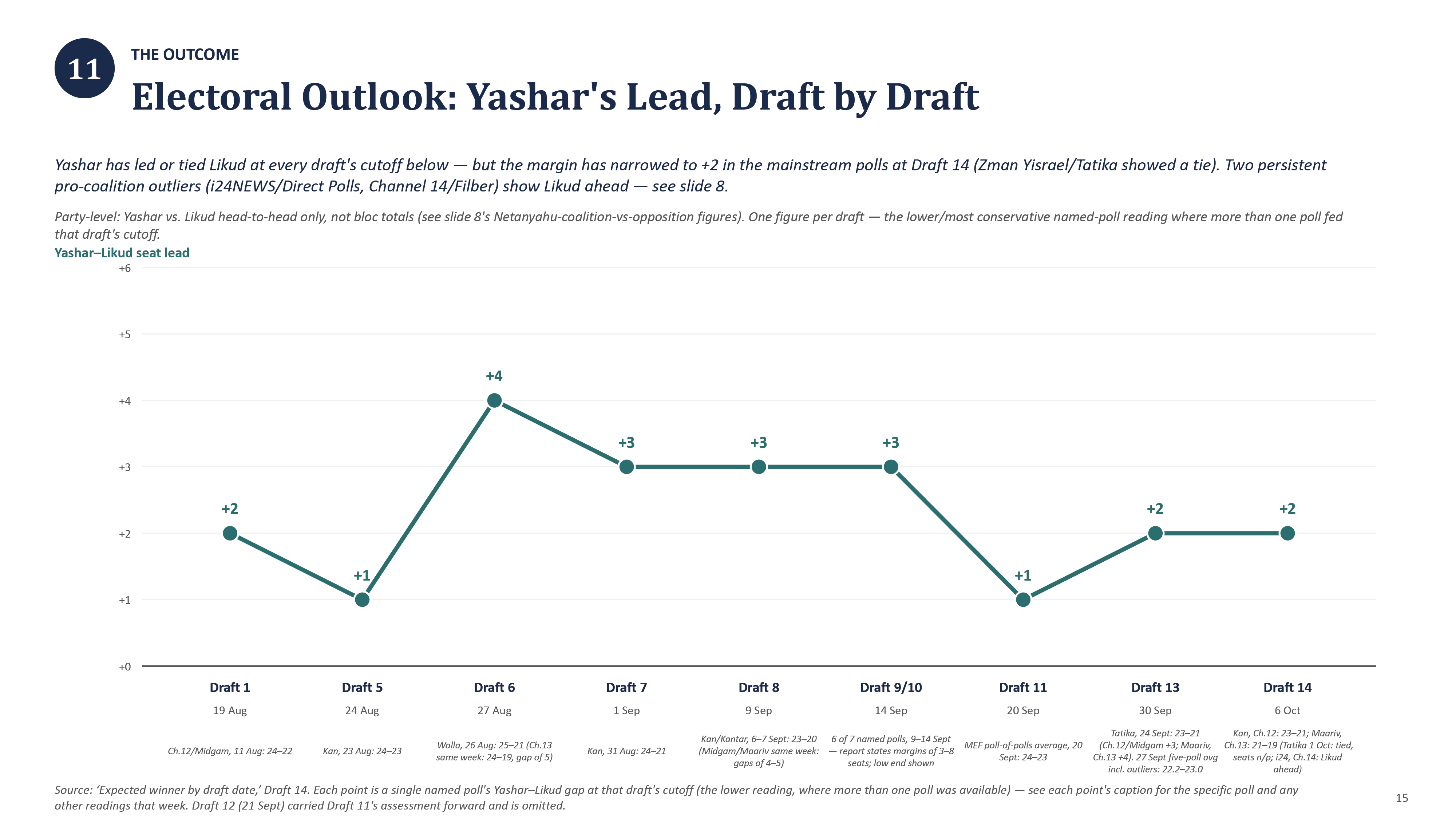
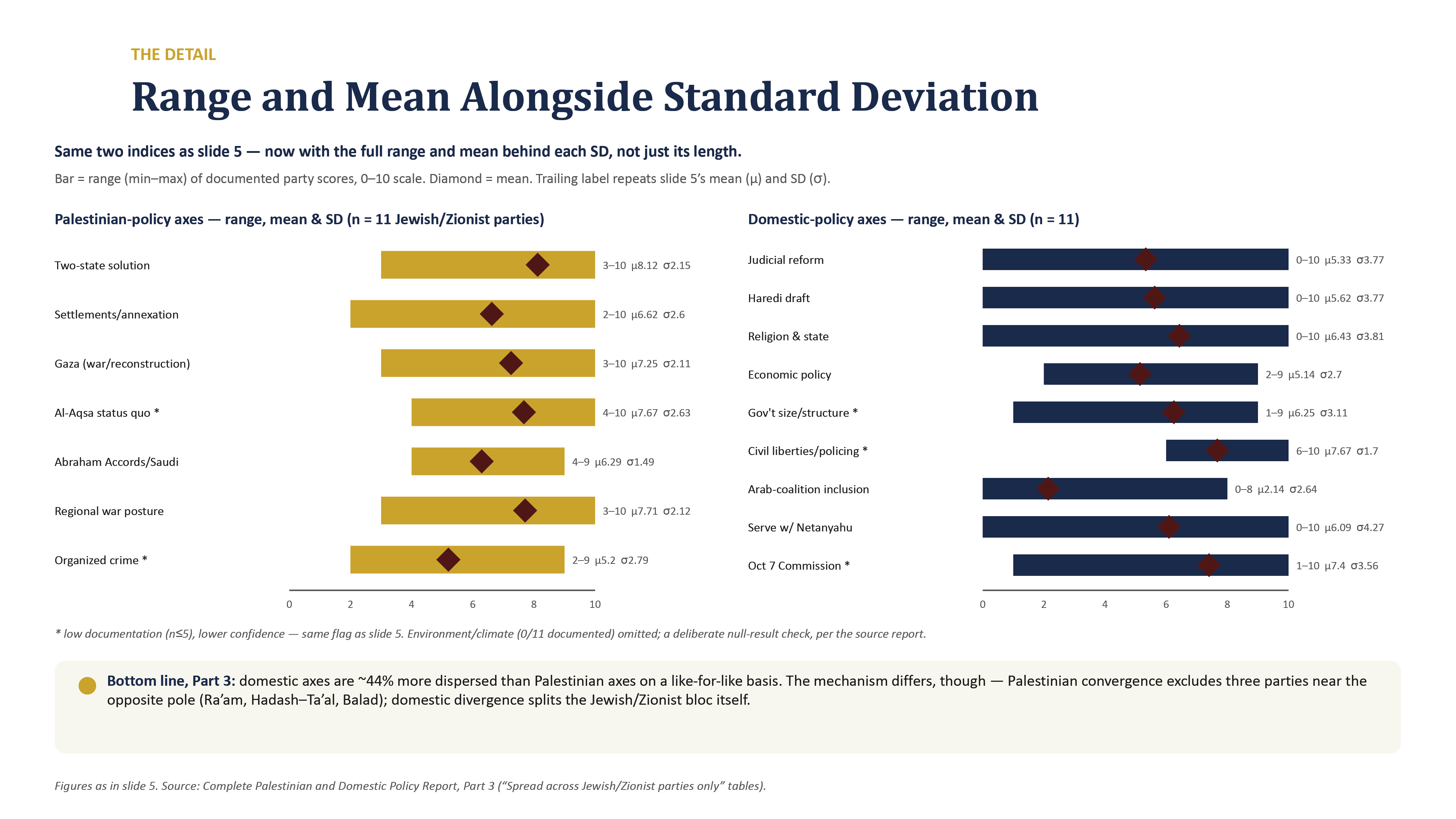
The paper’s key findings are as follows: Convergence on issues concerning Palestinians is broader than convergence on domestic issues. Zionist parties differ over how the conflict should be managed and over the limits of control, but most prioritize Israeli security considerations over Palestinian sovereignty and self-determination. The paper presents quantitative indicators to illustrate this pattern. Differences between the parties remain significant. Far-right parties advocate annexation and the re-establishment of settlements in Gaza, while opposition forces adopt security-oriented approaches that differ in their positions on these policies. The Democrats stand out for adopting positions more supportive of a political settlement and more opposed to occupation and settlement expansion. Arab parties represent the clearest exception to this broader convergence, supporting Palestinian statehood, an end to the occupation, and an end to the war, while differing over whether to participate in governing coalitions or support them from outside. A numerical majority does not necessarily translate into the ability to form a government. According to the polls examined in the paper up to 5 October, neither Netanyahu’s bloc nor the Jewish opposition holds a reliable 61-seat majority. Arab parties could therefore be decisive in numerical terms, but the refusal of some opposition forces to rely on their support complicates the formation of an alternative government. The outcome remains open to several possible arrangements, influenced by whether smaller lists cross the electoral threshold, the positions of the Haredi parties, and the possibility of forming a unity government or changing the leadership of Likud. The paper concludes that, from a Palestinian perspective, the most important criterion is the substance of the next government’s policies toward land, rights, and Gaza, rather than the identity of its prime minister alone. Elections may change the leadership, political balance, and some policy tools without necessarily transforming the foundations of the relationship with Palestinians. The paper attributes this to the fact that Israel, across its political spectrum, remains a settler-colonial state.
Methodology
As the Israeli elections scheduled for 27 October 2026 approach, much of the discussion has focused on Benjamin Netanyahu’s political future and the opposition’s ability to form an alternative government. For Palestinians, however, the more pressing question concerns the substance and limits of such a change: to what extent could a shift in the governing coalition lead to a change in Israeli policies toward Palestinians in the West Bank, including Jerusalem, the Gaza Strip, and inside Israel? And what do party platforms and positions reveal about the future of the occupation, settlement expansion, the war, and the prospects for recognizing the Palestinian right to self-determination?
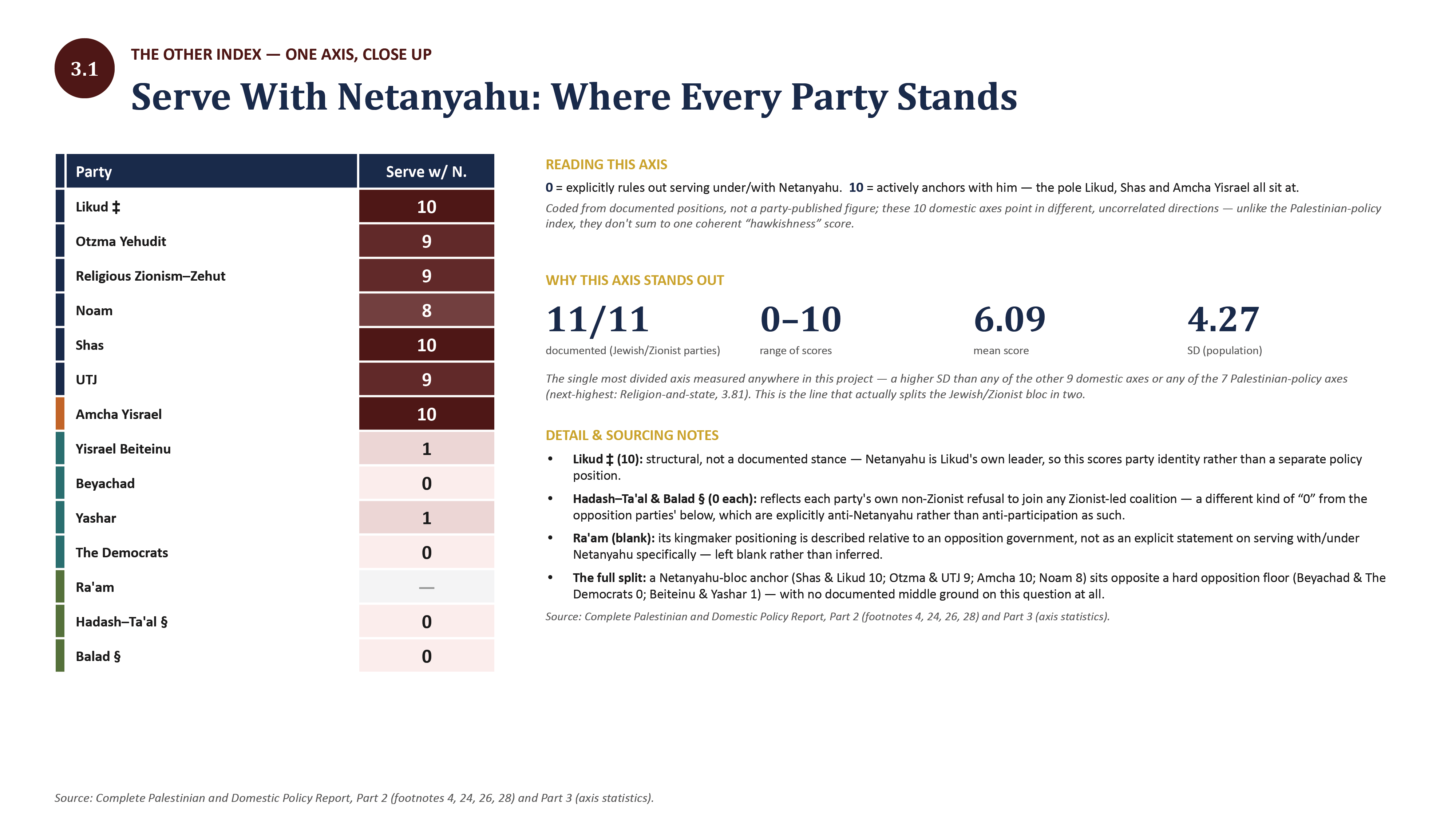
The importance of these questions lies in the need to distinguish between competition over the leadership of the state and its institutions, and disagreement over Israel’s relationship with Palestinians and their rights. The intensity of disputes over the judiciary, Haredi conscription, the relationship between religion and state, and responsibility for the events of 7 October does not, on its own, indicate the extent of disagreement over ending the occupation or establishing a Palestinian state. At the same time, the fact that many parties share a commitment to prioritizing Israeli security does not eliminate differences between them over annexation, settlement expansion, the future of Gaza, and approaches to Palestinian political representation. Reading the electoral landscape therefore requires examining both this common ground and the differences within it, and assessing the concrete implications each may have for Palestinians.
Against this background, RO’A Center for Political and Strategic Studies presents a comparative reading of the competing parties and electoral lists, bringing together their declared positions on the Palestinian question, their approaches to domestic governance issues, and their coalition preferences. The report is based on monitoring the party landscape from the beginning of August through 5 October 2026, drawing on party platforms, statements by party leaders, and available reports within a unified comparative framework. It also distinguishes between documented positions and issues for which sufficient information is unavailable, as well as between expected electoral weight and the ability to translate that weight into a governing majority.
On this basis, the report examines the degree of convergence and divergence among Israeli political forces, and the extent to which a change in government may be reflected in policies toward Palestinians. It proceeds from the premise that replacing the leadership does not, in itself, guarantee a change in these policies; rather, this depends on the substance of party programmes, the balance of power, and the commitments of the next coalition. In this way, the report seeks to provide a basis for understanding what the elections may change in the reality facing Palestinians, and what patterns of control and exclusion they may reproduce, even under a new government.
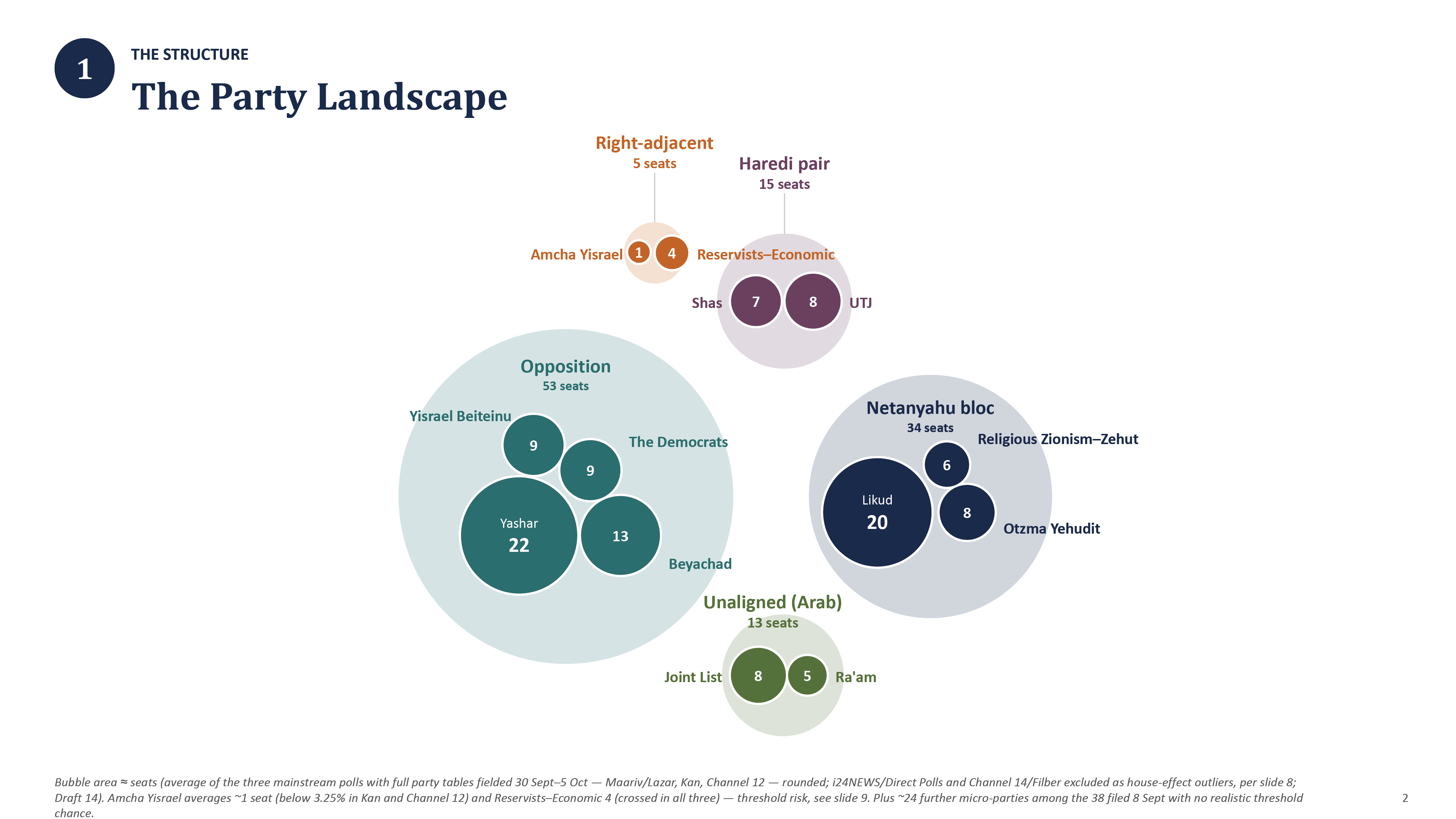
The report provides profiles of the Israeli parties that reach, or come close to, the 3.25% electoral threshold in opinion polls, equivalent to four seats, ahead of the 2026 Israeli elections scheduled by law for 27 October. For each party, the report addresses a fixed set of ten questions organized around two main pillars:
-
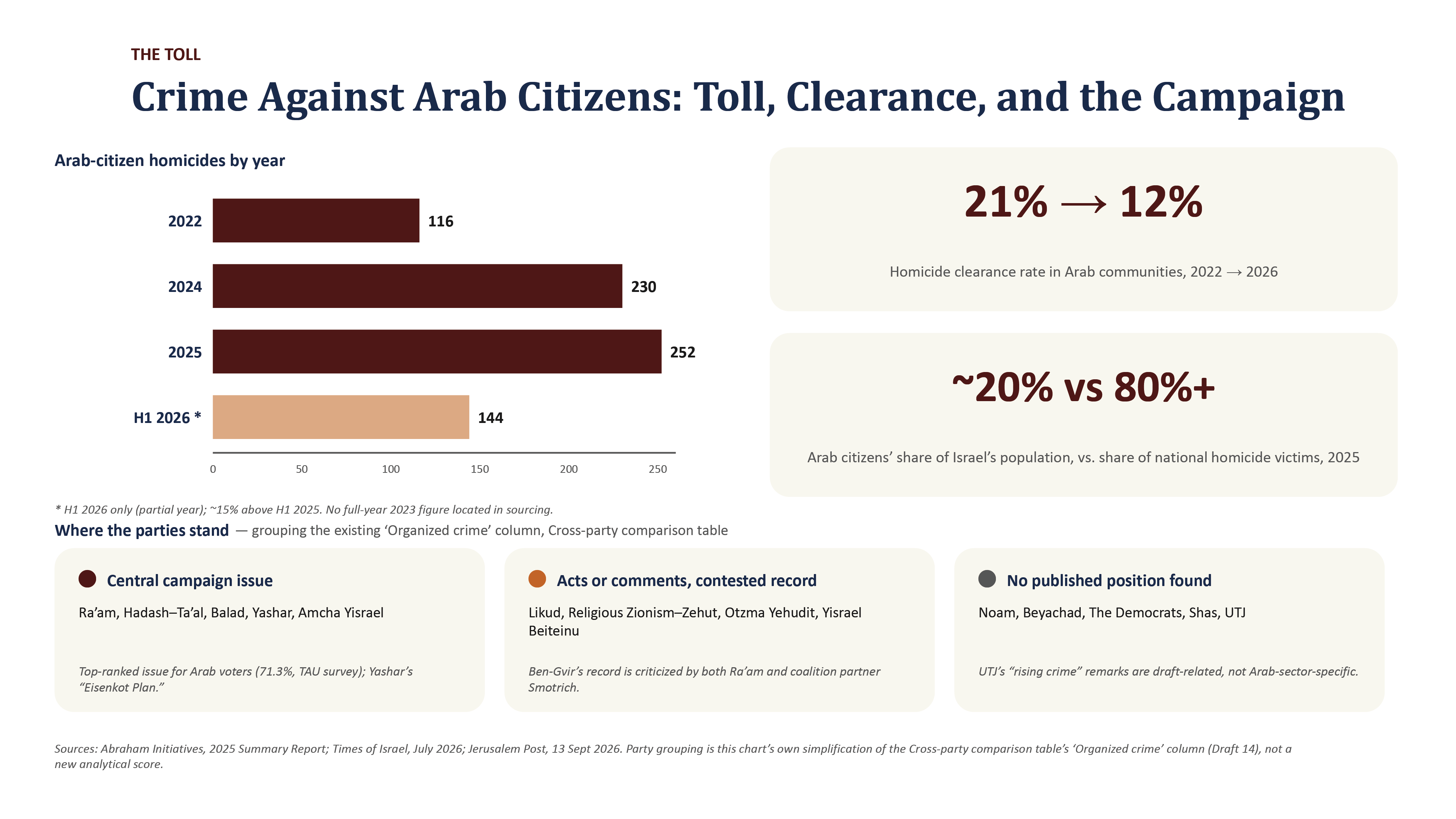
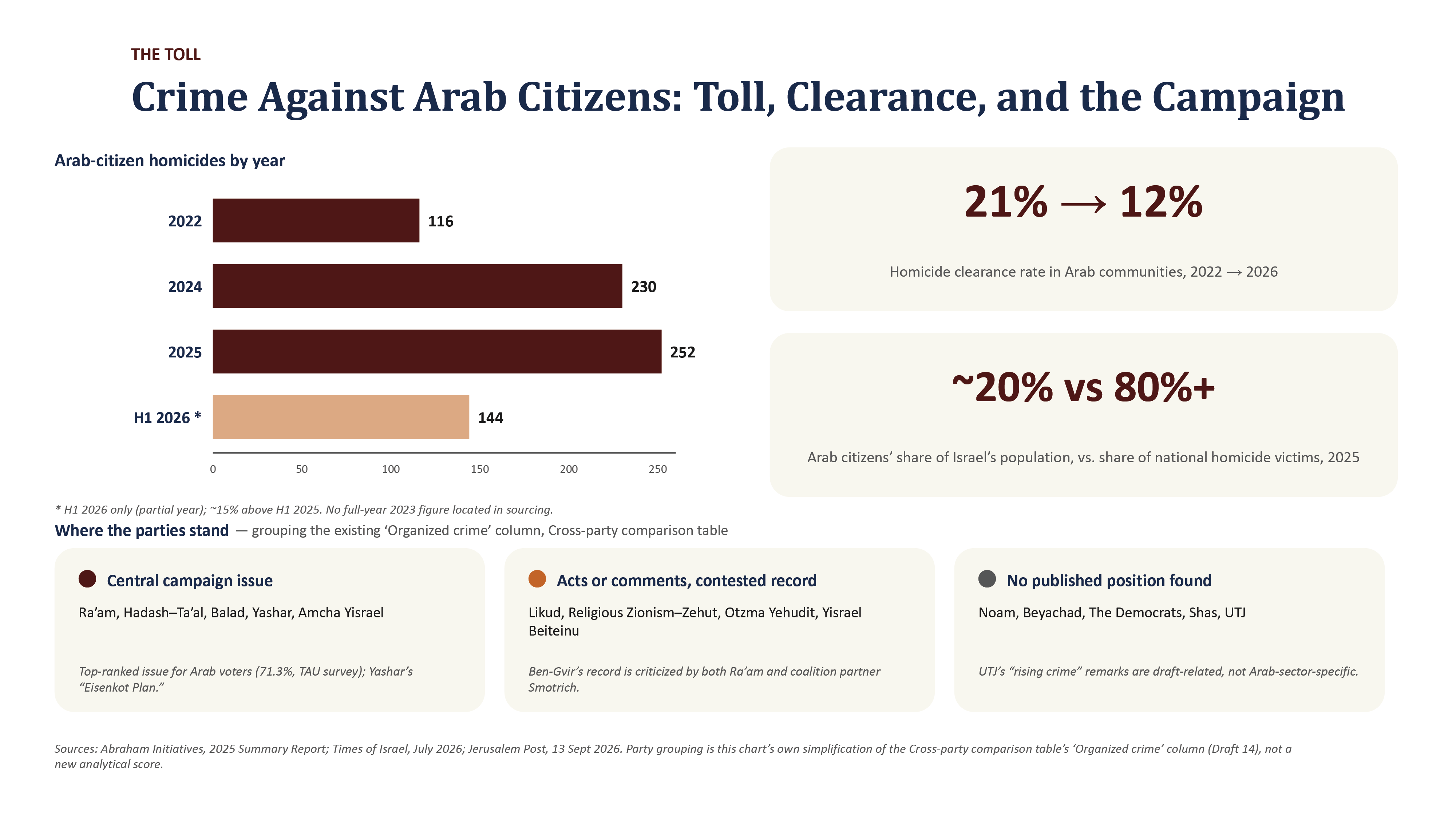
Policy positions related to the Palestinian question, including positions on the regional war involving Iran, Lebanon/Hezbollah, Syria, and Turkey, as well as organized crime and crimes against Arab citizens in Israel, as part of Israel’s external “security” policies.
-
Comparative sections on the parties and coalition calculations related to dimensions of domestic governance, including judicial reform, Haredi conscription, accountability for the events of 7 October, the economy, and other issues, as part of Israel’s domestic policies.
Key Findings
Issues
-
The Two-State Solution
-
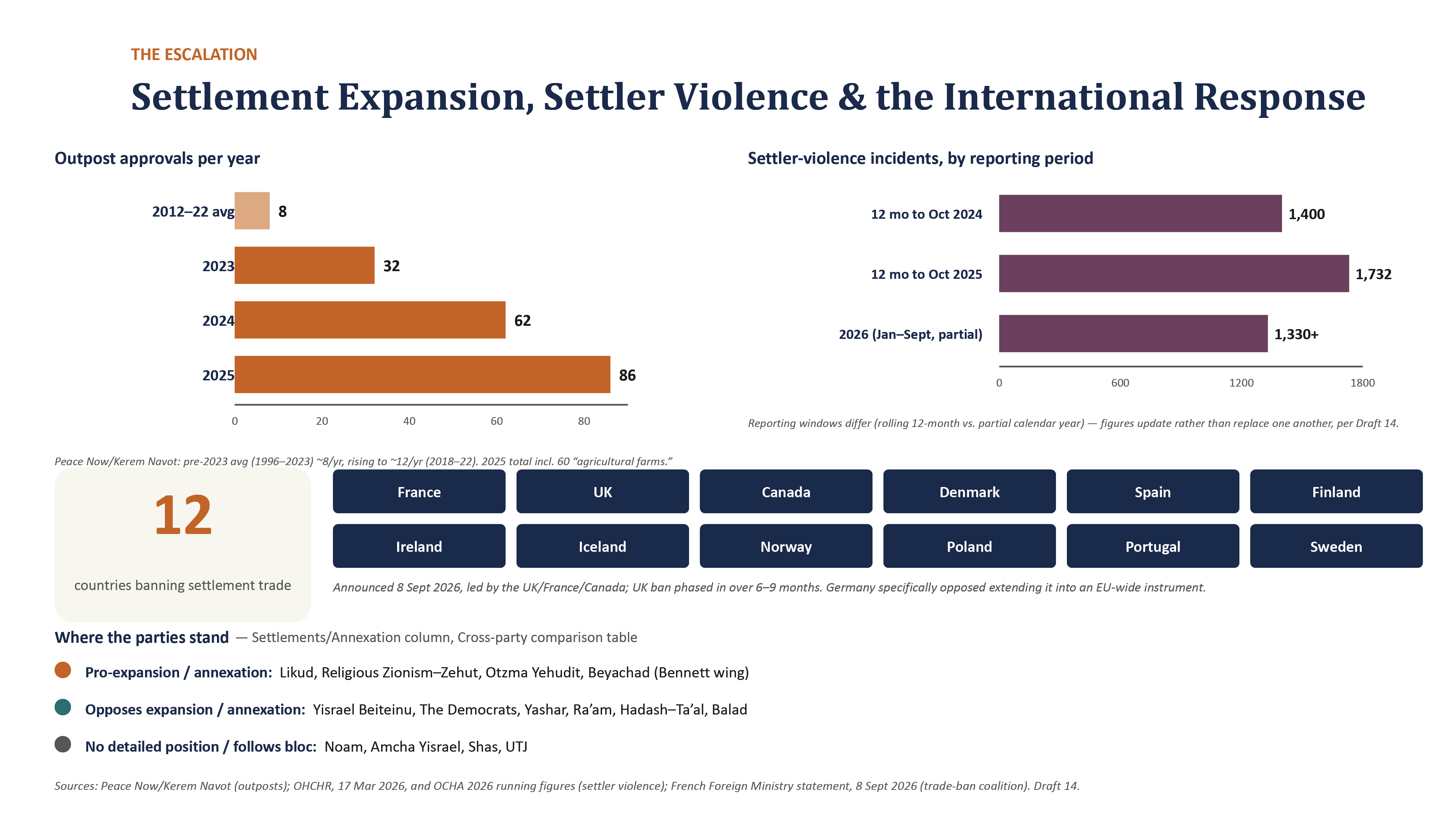
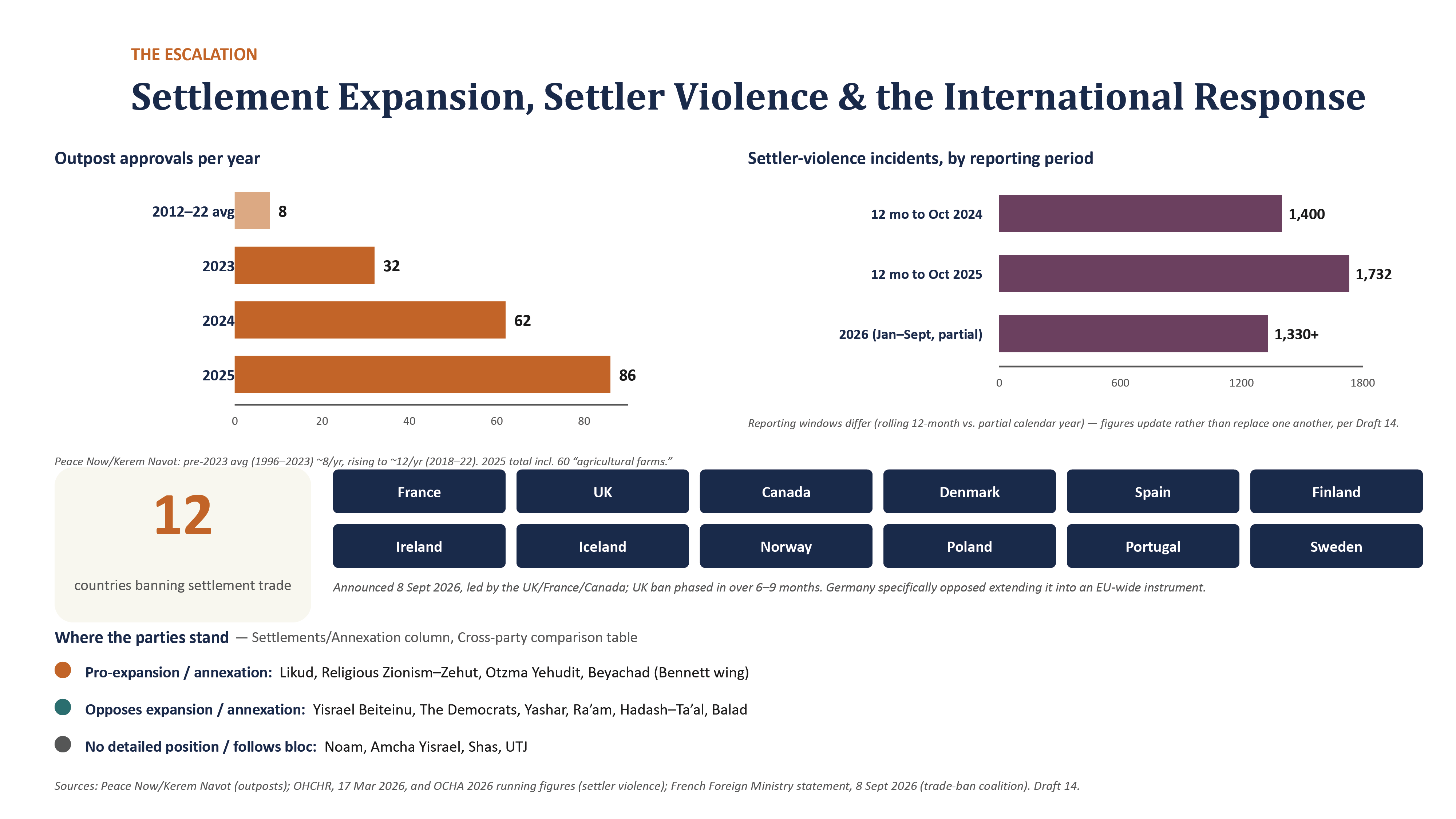
The occupation, settlements, and territorial expansion (annexation)
-
Gaza: management of the war and reconstruction
-
Checkpoints, settler violence, and anti-Palestinian economic policies, such as the withholding of tax revenues
-
Jerusalem and Al-Aqsa
-
Positions toward other parties and far-right extremists
-
Regional policy — the Abraham Accords / Saudi Arabia
-
Positions on the regional war — specifically Iran, Lebanon/Hezbollah, Syria, and Turkey
-
Organized crime and crimes against Arab citizens in Israel
-
Coalition formation; where a party platform includes a position on Haredi conscription, this is included as an additional item at the end of that party’s profile
Conclusion
The comparison between the parties competing in the 2026 elections shows that the intensity of divisions within Israeli politics does not necessarily translate into equally divergent alternatives on the Palestinian question. While the main political forces compete over leadership of the state, the organization of its institutions, and the relationship between religion, the judiciary, and the military, a broad segment of Zionist parties converges around prioritizing Israeli security in determining the future of Palestinians and the limits of their political rights.
At the same time, differences over annexation, settlement expansion, the future of Gaza, and the possibility of a political settlement remain consequential, even when these parties do not commit to ending the broader system of Israeli control.
Coalition calculations reveal further limits to the potential for change. The seats won by opposition forces do not automatically translate into a governing majority, as disagreements remain over partnership with Arab parties, Haredi conscription, and the conditions for cooperation among opposition factions. This highlights a contradiction between the importance of Palestinian political representation in government-formation calculations and the efforts of major Israeli political forces to restrict its legitimacy and exclude reliance on it.
The impact of the elections therefore depends as much on the composition of the next coalition, its commitments, and the balance of power within it as it does on the identity of the prime minister.
From a Palestinian perspective, any governmental change should be assessed through the policies it adopts and implements: Does it halt settlement expansion, annexation, and displacement? Does it end the war and blockade and allow for the reconstruction of Gaza under Palestinian leadership? Does it recognize the Palestinian right to self-determination and guarantee the rights and political participation of Palestinians inside Israel?
These questions provide a benchmark for assessing substantive change beyond narratives of restoring stability or reforming Israeli institutions.
Accordingly, the elections may redistribute power among the parties and alter some instruments of Israeli policy, but a change in leadership alone does not guarantee a change in the relationship with Palestinians. The evidence presented in the report supports a cautious reading of the prospects for change, taking into account differences in the level of documentation across parties and issues, as well as the potential gap between political statements and actual practice.
The decisive question remains the extent to which any future government is prepared to end policies that reproduce occupation and exclusion